Global youth unite for ecosystem restoration in Kenya









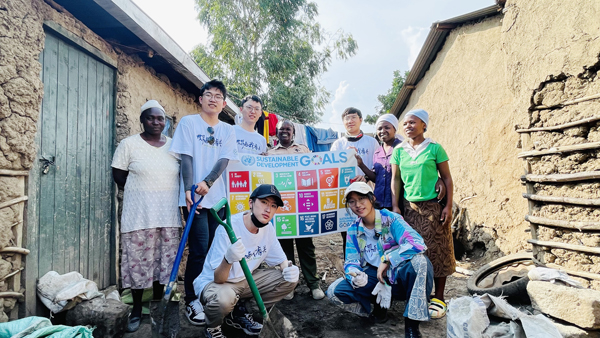
Under the scorching sun, we pulled out the last datura stramonium plant from the roadside, adding it to a growing pile that had formed a small hill. The intense heat seeped through our thick work gloves, and some of us suffered injuries from the plant's sharp spines. Yet, the hard work felt rewarding as we contributed in our small way to restoring the local ecosystem.
This task was part of Tsinghua University's overseas social practice program in Kenya, held from July 28 to Aug 10.
During the two-week program, we stayed at the Soysambu Conservancy, a nonprofit wildlife conservation organization, where we immersed ourselves in global volunteer work aligned with the United Nations' Sustainable Development Goals, aimed at protecting the conservancy's unique environment.
A key focus of our efforts was combating the spread of datura stramonium, an invasive toxic plant that has made areas of the conservancy uninhabitable for native wildlife and plants.
We also conducted observational studies on the conservancy's wildlife, gaining valuable insights into Kenya's wildlife conservation efforts.
Helen, a local volunteer, guided us throughout our experience. As an expert on giraffes, she has the remarkable ability to distinguish each of the approximately 180 giraffes by the patterns on their skin, which appear identical to our untrained eyes.
"They are unique, much like human fingerprints," Helen explained.
Despite coming from different backgrounds, the volunteers all shared a deep passion for wildlife. As members of Generation Z, we recognize the urgency of achieving sustainable development, and protecting the environment is a crucial step toward that goal.
I vividly remember a Japanese volunteer named Sakura, whose face lit up with joy whenever she talked about her love for zebras and giraffes.
Paula, a volunteer from the United States, told me she had adopted a vegan lifestyle to contribute to environmental protection.
"But I believe all 17 Sustainable Development Goals are equally important," she said.
"You all have the potential to become conservation ambassadors," said Tonny, a local volunteer, during a lecture on endangered giraffes. "We must all be part of one big family that understands the importance of conservation."
On our second day at Soysambu, we participated in a small youth forum, engaging in discussions with volunteers from around the world. This experience helped us break down stereotypes about Africa and truly feel like part of the big family Tonny had spoken about.
"We initially thought Africa would be extremely hot, but upon arriving in Kenya, we were surprised by the cool climate," said Qian Tian, also a member of our THU team, to Hendrik, another local volunteer.
There are considerable cultural differences between China and Kenya, noted Tang Jianjun, counselor of the Chinese Embassy in Kenya, during our visit to the embassy.
He emphasized that despite these differences, Kenya remains a steadfast friend of China and a model for the shared future community between China and Africa — and indeed, for all of humanity.
Though our volunteer work is small in scale, I believe our efforts are both symbolic and meaningful.
China-Kenya cooperation in wildlife conservation was highlighted by Vincent Obanda, principal research scientist at Kenya's Wildlife Research and Training Institute, who pointed out how initiatives like the Forum on China-Africa Cooperation (FOCAC) — held this year from Sept 4 to 6 in Beijing — enable collaboration on critical environmental issues.
As millennials who have grown alongside the development of the FOCAC, we bear the responsibility of deepening the China-Africa friendship and promoting mutual development.
As students from THU and global citizens of the 21st century, we are committed to advancing the Global Development Initiative through our actions, using our energy and passion to contribute to global progress.
Written by Mu Ruiying, 19, a sophomore at Weiyang College, Tsinghua University, double majoring in the basic science of mathematics and physics, and engineering physics.