


Two great civilizations share a cup of knowledge










"Collectively, they have offered us a worldview and a reference point from where we could examine our own cultural traditions," says Ma Minghe, who has been to all three shows.
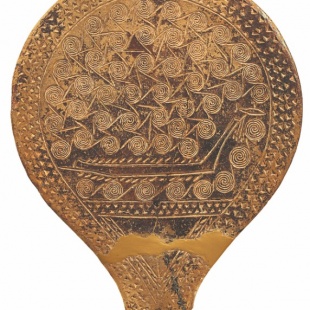
Back at the Nanjing Museum exhibition, a frying pan-shaped clay vessel dating between 2800 BC and 2300 BC is decorated with the image of a multi-oared longboat. The boat is surrounded by sea waves, as suggested by the repeated spiral pattern.
"Ancient Greek civilization is an ocean civilization in the true sense of the word," says Guan.
The item, a piece of tin-glazed pottery dating to the 16th century BC, is on loan from the National Archaeological Museum in Athens, which also has among its collection a seashell-shaped ceremonial drinking vessel known as a rhyton. More than 2,200 years later, similar-shaped vessels, often made of precious metals or stones, would travel the ancient Silk Road to the capital of China during the Tang Dynasty (618-907), where they were known as the laitong cup, laitong being a homophone to rhyton.
A superb example was unearthed in 1970 from what's believed to be a Tang Dynasty storage of precious items in a small village located in the southern suburbs of Xi'an city, the one-time capital of Tang. Known today as Hejiacun Village Hoard, this treasure trove is widely viewed by archaeologists as offering compelling evidence to the level of material exchange going on across the ancient trade route.
Buried with many pieces of Sassanianstyle gold and silver wares was this rhyton wine vessel carved out of beautifully striated agate into a horned bull head whose streamlined, upward-bending curve recalls the ascending spiral of a magnificent seashell. The bull's nose, minted in gold, serves as the vessel's stopper, with glitter accentuated by the muted colors of the agate.
Between this agate rhyton, believed to have been brought to Tang China by Sogdian merchants who dominated the ancient Silk Road between the 4th and 7th centuries, and the seashell-shaped one from ancient Greece, there were numerous others produced over large areas of ancient Eurasia, particularly from Persia to the Balkans. Very often, they took the shape of an animal's head or a bullhorn.