


Qinghai-Tibet Plateau research offers insight into effects of climate change
Warmer and wetter conditions impact ecosystems on 'roof of the world'










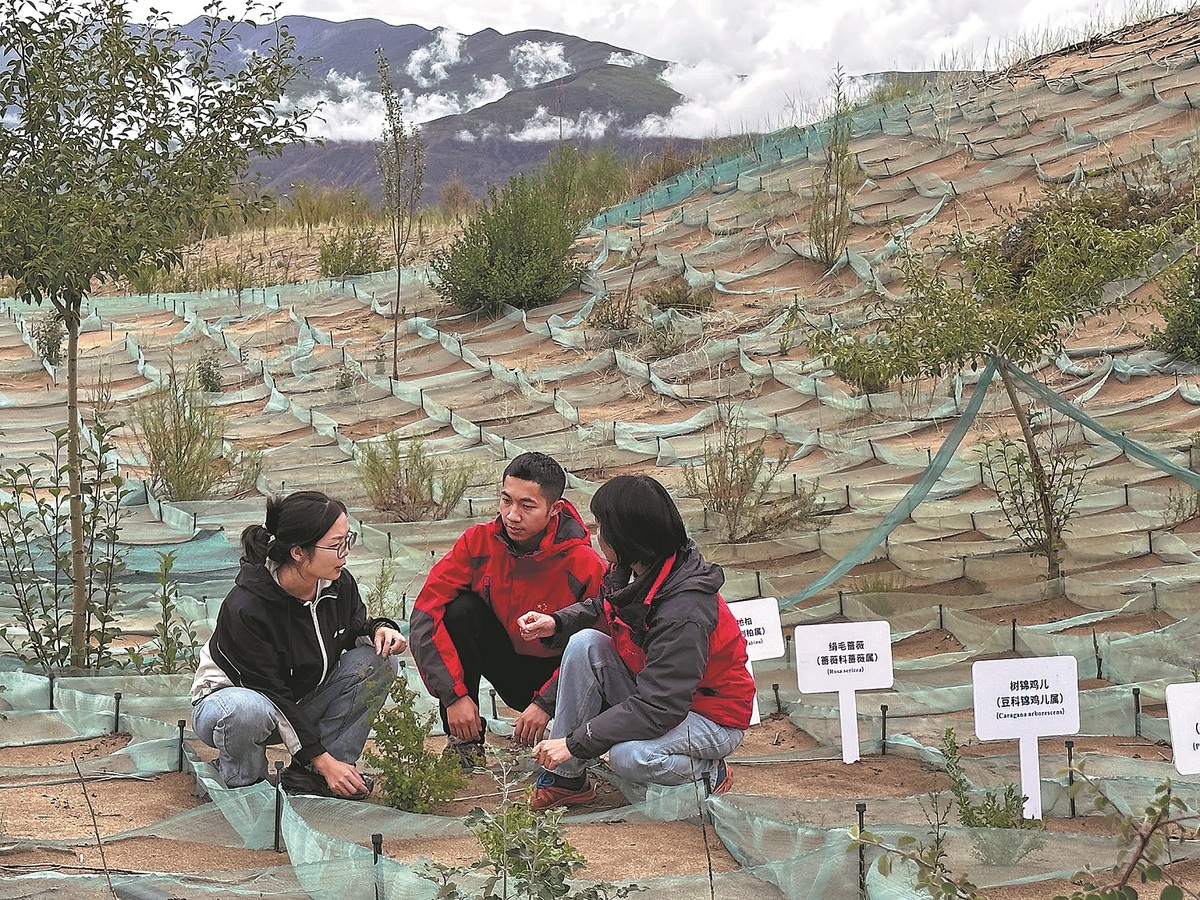
Less than an hour's drive from the site is a plot of experimental land dedicated to desertification research.
"We are conducting transplant experiments on grass and shrubs here to test their resistance. By evaluating their growth and winter survival rates we can select plant varieties that are suitable for growth in alpine sandy areas," said Zhou Ping, a researcher at the institute.
Scientists at the institute are providing insights into the plateau's role as a carbon sink.
Researchers found that 26 out of 32 monitoring sites were still significant carbon sinks from 2002 to 2020, and that the carbon absorption rate was more substantial than previously thought.
"The strongest net carbon sink effect along the Qinghai-Tibet Plateau occurs at an altitude of 4,000 meters," said Wei Da, a researcher at the institute who coauthored a study published in the Proceedings of the National Academy of Sciences, a peer-reviewed journal of the academy in the United States.
"Our study has determined that the alpine ecosystems on the plateau remain a powerful carbon sink. The consistently warm and wet climate on the plateau is conducive to plant growth and can drive stronger carbon sink effects," he said.
In another study that was released in Nature Communications, an open-access international journal this year, researchers found that high-altitude and colder ecosystems, including the Qinghai-Tibet Plateau, are more sensitive to climate warming than terrains at a lower elevation.
By combining machine-learning tools with monitoring data and climate change analysis models, the study concluded that high-elevation environments respond consistently to a warming climate and may play a positive role in mitigating the effects of climate change.
"Climate change in mountainous areas and human activities are extremely complicated, and go well beyond our existing knowledge," said Wei.
He said that questions such as how much carbon emissions will result from thawing permafrost, the impact of extreme weather on curtailing plant growth, and how to regulate and improve carbon sinks remain unanswered.
"The closer we are to the mountains, the more questions emerge," said Wei. "But these unknowns also motivate us to keep advancing research."
wangxiaoyu@chinadaily.com.cn





