



Green firms aim to break through trade barriers









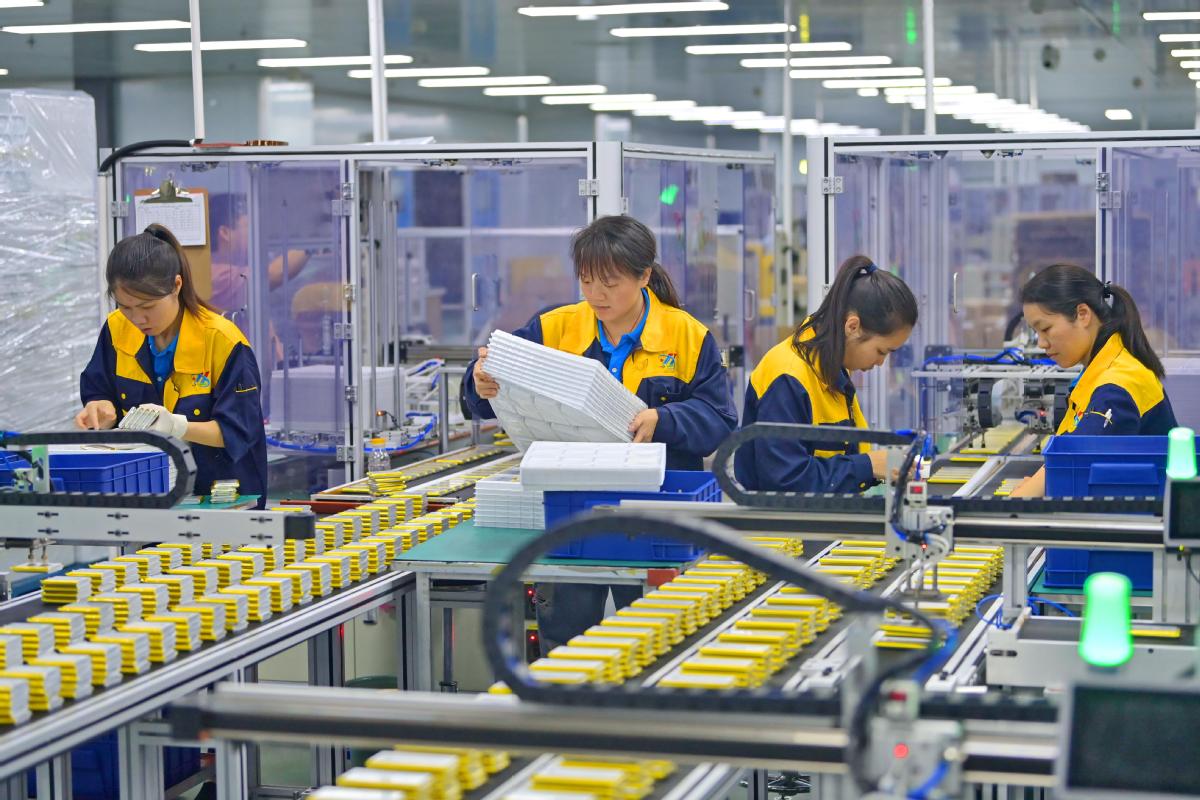
Chinese enterprises in the new energy sector, facing escalating trade restrictions initiated by some economies, are proactively adopting diversified strategies to ensure continued growth, with a focus on establishing overseas manufacturing facilities and exploring emerging markets, experts said.
China's electric vehicles, lithiumion batteries and photovoltaic products, dubbed the country's "new three" export categories, have seen remarkable growth in overseas shipments in recent years.
Driven by the accelerated global transition toward green energy, the combined annual export volume of these products surpassed 1.06 trillion yuan ($148.3 billion) last year, said the General Administration of Customs.
Leveraging economies of scale and continuous technological innovation, China has established a leading global position across the value chains of these burgeoning industries, said Liang Ming, director of the Institute of International Trade, which is part of the Chinese Academy of International Trade and Economic Cooperation.
However, the rise of trade protectionism in certain countries has posed challenges to the global expansion of China's "new three "exports.
The United States, in May, decided to significantly increase tariffs on a range of Chinese products in the green tech sector. As well as a tariff increase from 25 percent to 100 percent on Chinese EVs, levies will rise from 7.5 percent to 25 percent on lithium batteries, and from 25 percent to 50 percent on solar cells.
Following Washington's stiff new tariffs, the European Union announced in July that provisional additional tariffs of up to 37.6 percent will be slapped on Chinese-made battery EVs.
Both Washington and Brussels, despite recognizing the importance of these sectors, lack the competitive edge enjoyed by China. This has led them to implement protectionist policies, aiming to create space for their own nascent industries, Liang said.
As trade protectionism continues to cast a shadow over Chinese business, proactive steps such as establishment of overseas manufacturing plants and diversification of export destinations have been adopted to navigate these challenges, analysts said.
In early June, a free trade agreement between China and Serbia came into effect, with both sides agreeing to eliminate tariffs on 90 percent of tariff lines reciprocally.
This includes key Chinese exports such as automobiles, photovoltaic modules and lithium-ion batteries, which will see their tariffs gradually reduced from the current 5-20 percent range down to zero when entering the Serbian market.
While Serbia's market size may not directly translate into significant export volume for China's green products, the China-Serbia FTA holds long-term strategic importance for expanding these clean energy technologies across the European market, said Dong Zhongyun, chief economist at AVIC Securities.
Exports of China's "new three "products can help Serbia accelerate the transformation of its energy system in a more cost-effective and efficient manner, Dong said, adding that this can serve as an example for other European countries, paving the way for deeper market penetration across the continent.
As China's manufacturing enterprises increasingly invest in countries like Serbia, Hungary, and Poland, surging demand for renewable energy solutions in these regions has become a key focus for the export of China's clean energy products, Dong said.
Beyond the traditional markets of Europe and the US, the need for power system upgrades and energy transitions in Central Europe, the Middle East, South Africa, Latin America and Southeast Asia has emerged as a strategic priority for the global expansion of China's "new three" exports.
In a series of recent strategic moves, several leading Chinese new energy enterprises have recently announced major investments and partnerships in Saudi Arabia.
Notably, Chinese photovoltaics manufacturer Sungrow Power Supply has signed three landmark energy storage contracts with Saudi Arabia's Algihaz Holding, amounting to the world's largest grid-side storage order. Each project will have a capacity of 2.6 gigawatt-hours, totaling 7.8 GWh.
China's rise as a clean energy powerhouse is the result of its commitment to an open and innovative approach. Protectionist trade policies, on the other hand, only serve to undermine the long-term competitiveness of industries, said Chen Wenling, chief economist at the China Center for International Economic Exchanges.











