Right alternative










China and the Global South are striving to create the conditions to bring about peace in the Middle East and Ukraine
Looking around the world it seems that conflicts of all sorts are on the rise. The Middle East dominates much of the international coverage following Israel's lengthy onslaught on Gaza. In Europe, the Russia-Ukraine conflict continues, with a sense on both sides that it represents something existential.
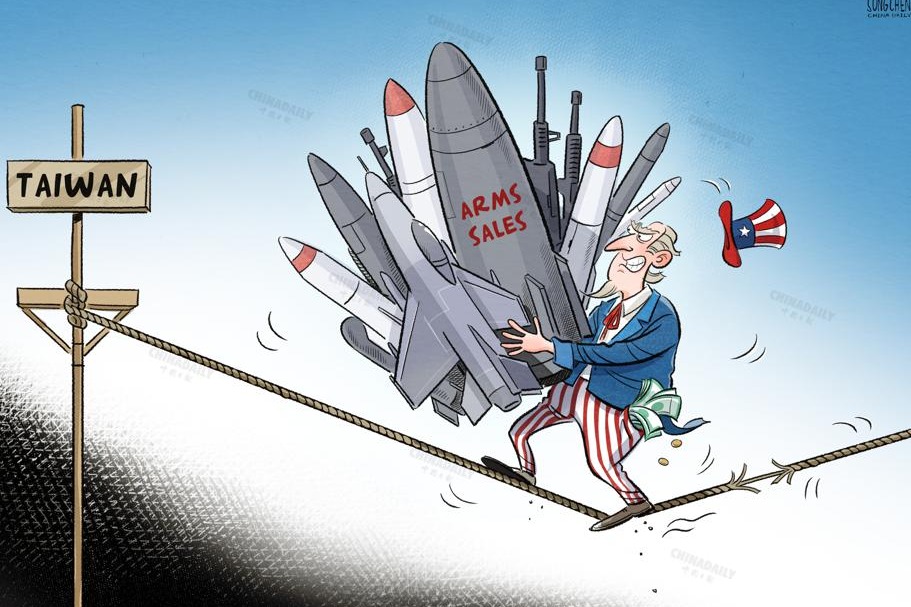
In both cases, the world's sole superpower for a generation, the United States, has done little to halt or prevent conflict. Instead, it seems to have facilitated its continuation.
When it comes to Israel, the US has offered material, military, political and diplomatic support. Whether the Israeli government has hijacked US strategic interests to drive this conflict remains a matter of analytical debate. But the consequences are an Israel which believes it must remain dominant in the region and is intent on coercion and conflict — rather than peace or justice — seems to be the goal.
In Ukraine, all the protagonists — including the US and NATO — want victory first and peace second. While the state of the conflict is hard to read through the propaganda on all sides, it looks as though fighting will continue for some time and could even escalate further. Thinking about the difficult choices and compromises required for peace is being pushed at least beyond the US election at the end of this year. For the moment, there is no obvious road to peace.
In this context, what is the significance of Chinese diplomatic efforts to promote peace through two initiatives in late July?
The first initiative was the agreement brokered in Beijing between rival Palestinian factions, primarily Hamas and Fatah. Their declaration, agreed on July 23 after what the Chinese Foreign Ministry called "lengthy negotiations", committed the two parties to strengthen unity and heal rifts, along with other Palestinian factions.
History suggests this will not be easy, and the agreement was met with cynicism in much of the West given the long history of Palestinian factionalism. But things have changed since October last year. The extent of the Israeli onslaught has demonstrated the need for Palestinian unity. And it has become widely accepted among analysts — if not yet politicians — that part of Israel's strategy has been to divide and rule. Much of international opinion, including the majority of public opinion in the West, has turned to favor the Palestinians.
Going forward, the incentives for Palestinian unity are therefore significant. China's initiative is a step in the right direction, and its ongoing support could play a crucial role in promoting Palestinian solidarity, something that is much needed for a sustainable solution.
The second Chinese initiative saw Ukraine's foreign minister visit Beijing at the end of July.
The dynamics of this conflict are rather different. China clearly has good relations with Russia, but it is unclear how much diplomatic leverage Beijing enjoys in Moscow. In spite of efforts to remain broadly neutral in the conflict, China has had a much more difficult relationship with Ukraine. But the Ukrainian foreign minister's visit suggests some scope for Chinese mediation may have emerged.
This will not be at all easy to pursue. The conflict on the ground shows no signs of abating, and Ukraine's leadership appears determined to redouble efforts to take the fight to Russia, as the recent incursions into Russian territory show. Prospects are further complicated by the fact that Russia and Ukraine are far from the only parties to this conflict.
The road to peace looks long and winding in both these cases. But this makes it even more important to make efforts to engage in diplomacy and dialogue. Over time, perhaps they can create space for compromises which can increase the prospects of peace.
This may sound as if it is not a very ambitious objective. But it is incumbent on those in the Global South, starting with China, to do everything possible to demonstrate that there may be alternatives to the approach adopted by the US-led West.
Recent Chinese diplomacy appears to have support from many parts of the world. While ongoing conflicts show that the entrenched power of the West remains significant, the rise of the Global South offers hope that the stumbling blocks to peace can gradually be removed.
The author is a research affiliate of the Lau China Institute at King's College London and an assistant professor at the Centre for China Studies at the Chinese University of Hong Kong. The author contributed this article to China Watch, a think tank powered by China Daily.
The views don't necessarily reflect those of China Daily.
Contact the editor at editor@chinawatch.cn.