


Cooperation with Cairo breaks new ground for Chinese archaeologists










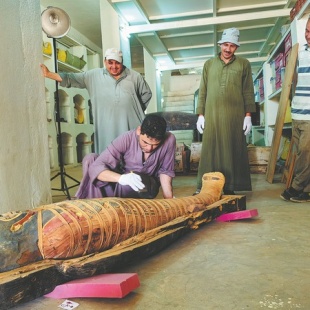
Major cooperation projects between China and Egypt focusing on the digital scanning, photography, sorting and research of some 1,000 humanoid wooden coffins unearthed in Saqqara, Egypt, have been underway since May, according to the Shanghai International Studies University.
The university made its announcement about the China-Egypt Joint Investigation, Research and Digitalization Project on Ancient Egyptian Antiquities, on June 24.
All the coffins have been unearthed by the archaeological team of the Supreme Council of Antiquities of Egypt at the Bubasteion Site in northern Saqqara, which is home to some of the oldest pyramids in Egypt, since 2018.
The project was carried out by the university's World Arthistory Institute, the Saqqara Archaeological Team and other teams from Egypt, and was led by Xue Jiang, an assistant researcher at the institute. The final research results will be released simultaneously in Chinese, Arabic and English.
This was "the first time China carried out such a large-scale basic cultural project outside the country", according to the university, as it will provide valuable experience and serve as an example for the implementation of follow-up projects. These include the upcoming Database on Ancient Greek-Gandharan Images, Literature, and Archaeological Artifacts, which is affiliated to the university's World Civilizations Research Database.
The project is the latest example of the increasingly strong partnership between China and Egypt. Strengthening people-to-people exchanges and deepening friendship between the two countries are essential to promoting common development and prosperity, according to the scholars.
Mutual learning between China and Egypt has also entered a new paradigm, one no longer limited to single archaeological projects, but which will establish the comprehensive collation and research of Egyptian civilization, and make use of technologies, such as databases and artificial intelligence, to carry out systematic, long-term research, according to experts.
On a visit to the Shanghai university in May, Mohamed Ismail Khaled, PhD, secretary-general of Egypt's Supreme Council of Antiquities, expressed his full support. He said he believed the project was innovative in terms of the mechanism of mutual learning and exchange between China and Egypt as ancient civilizations.
Li Yansong, president of the Shanghai International Studies University, says that he expects the project to enhance the school's studies of countries and regions, provide fresh support for China-Arab cooperation under the Global Civilization Initiative, and boost mutual learning and exchange with all parties in Egypt.
Zhu Qingsheng, the initiator of the project, says that in the era of digital technology, it is necessary for artifacts to be more comprehensively analyzed through technical means and made known to the public.
"This marked an important beginning for the continuation of the cultural traditions of China and Egypt, for conducting dialogue among civilizations on an equal footing, and for carrying out international cultural cooperation in a new form," says Zhu, who is also director of the World Arthistory Institute and a professor of history at Peking University.
"For a Chinese university to enter an Egyptian archaeological site with new image theory, database concepts and micro-trace scanning to collect and sort finds is a new academic strategy," he says.
Yan Haiying, who is in charge of the project's academic affairs, says that it was an unprecedented experience for Chinese researchers majoring in Egyptology to participate in sorting out unpublished firsthand information.
"The digital collection, sorting, research and interpretation of important artifacts signifies that Egyptology in China stands at the forefront of the world. The discovery and research of these new finds will change some theories and research in Egyptology itself," says Yan, a professor of history at Peking University, and a distinguished professor at the institute.
The project, which was based on the joint efforts of five researchers from China and six from Egypt, is expected to score several firsts for Chinese scholars involved to Egyptology, Xue says.
For example, Chinese scholars will jointly publish research results and present artifacts digitally with their Egyptian counterparts. The projects also marks the first time an ancient civilization from outside of the country has been invited to participate in the World Civilizations Research Database, he says.
zhouwenting@chinadaily.com.cn