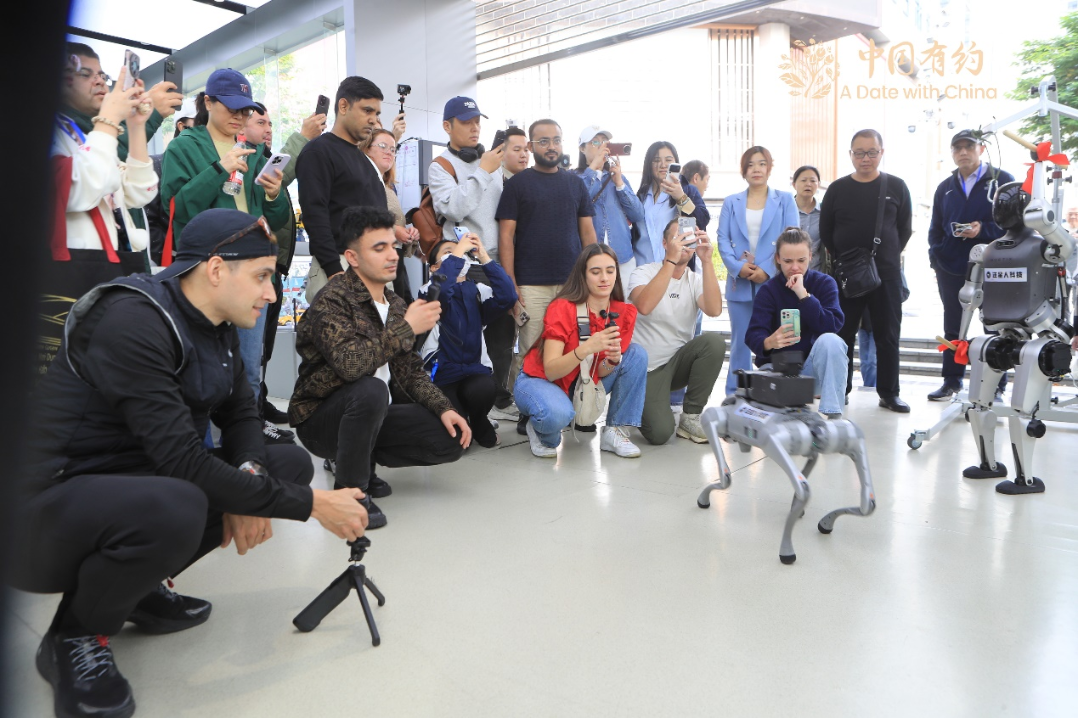
Humanoid robot industry gains momentum, boosting China's economy










SHENZHEN - In an automotive factory, silver humanoid robots stride along assembly lines, conducting tasks once performed exclusively by humans -- from car scanning to seatbelt inspection and affixing labels onto vehicles.
This is not a scene from a sci-fi movie, but a collaboration between UBTECH, a Shenzhen-based robotics firm, and Chinese electric carmaker NIO, highlighting the rapid advancement in China's humanoid robot industry.
As competition intensifies among manufacturers, humanoid robots are increasingly being integrated into various sectors, with industrial applications leading the charge.
Earlier this month, UBTECH announced it would work with FAW-Volkswagen, one of China's earliest joint venture automakers, to develop an unmanned car factory. This initiative aims to deploy UBTECH's industrial humanoid robot, Walker S, at FAW-Volkswagen's plant in East China's Qingdao, where the robot will undertake tasks such as bolt tightening, component assembly, and handling automotive parts.
Experts consider industrial manufacturing, commercial services, and family companionship the primary applications for humanoid robots. Among these, industrial manufacturing is poised to lead the way.
At the Innovation Conference 2024 held in Shenzhen, a technology hub and metropolis in southern China, over the weekend, Pang Jianxin, vice-president of UBTECH, said that humanoid robots were increasingly penetrating critical sectors of the manufacturing industry, including automobiles, computers, communications, and consumer electronics.
"The standardized nature of industrial manufacturing makes it an ideal initial application area for humanoid robots," Pang said, highlighting that China's robust industrial base provides fertile ground for humanoid robot development.
Deep integration into industrial manufacturing will significantly enhance the tool manipulation and task execution capabilities of humanoid robots, Pang said.
China aims to establish a preliminary innovation system for humanoid robots by 2025, according to a guideline from the Ministry of Industry and Information Technology. By 2027, the country will see a secure and reliable industrial and supply chain system, and related products will be deeply integrated into the real economy.
Chinese robotics firms are at the forefront of advancing humanoid robot technology, achieving significant breakthroughs in both lower and upper limb functionalities.
LimX Dynamics has tackled the challenge of dynamic motion control in humanoid robots' lower limbs by developing specialized algorithms for motion planning, state estimation, and whole-body coordination. The company's humanoid robot now performs continuous running motions, seamlessly synchronizing arm movements with lower limb actions.
Meanwhile, in the realm of upper limb design, companies like PaXini Technology are pushing boundaries in sensitivity and coordination. PaXini's humanoid robot features tactile hands capable of distinguishing between the skin of an elderly person and that of a child.
Nie Xiangru, co-founder of PaXini Technology, emphasized the importance of tactile perception in human hands. To replicate this capability, the company independently engineered multi-dimensional surface array tactile sensors, enhancing the robot's ability to perceive and respond with a flexible sense of touch akin to human capabilities.
Xiong Rong, a professor at Zhejiang University, said that humanoid robots were designed in the human form to maximize versatility and facilitate seamless integration into social environments.
According to a report released at the First Chinese Humanoid Robot Industry Conference in April, China's market scale of the humanoid robot industry is predicted to reach 2.76 billion yuan ($387 million) in 2024 and 75 billion yuan by 2029.
Despite all the advancements, experts at the conference held over the weekend cautioned that the journey toward ubiquitous humanoid robot use is still in its infancy, particularly in complex household and commercial settings where human-robot interactions require flexibility and adaptability.
Pang said that the future development of humanoid robots required further research and development of high-performance motors, sensors and other core components.
"Perhaps new materials like artificial muscles could potentially revolutionize humanoid robot design, enabling a shift from rigid to flexible power-driven mechanisms," Pang added.