


Sanxingdui's mysteries enthrall Beijing museumgoers









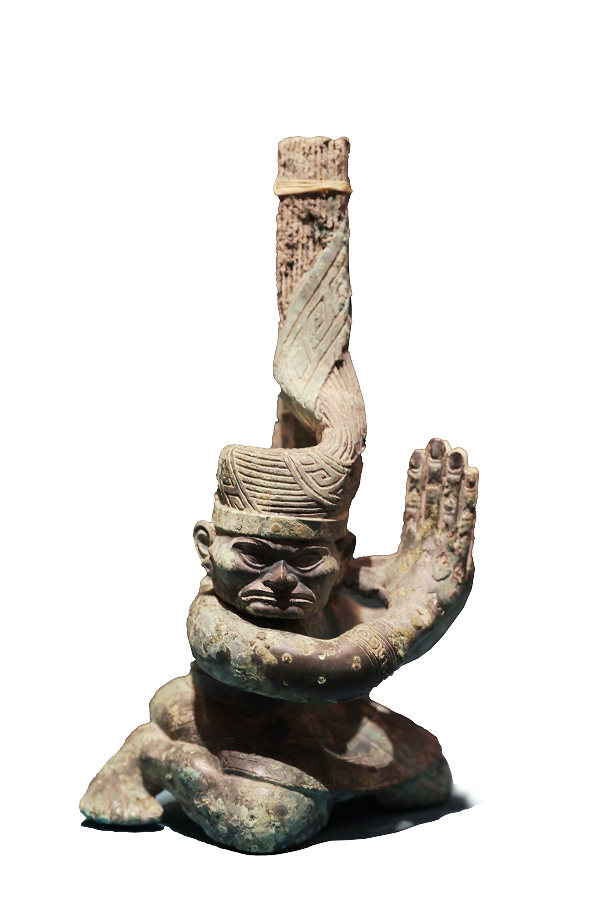
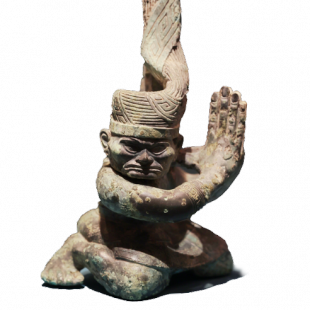
The bronze statue, depicting a man kneeling, twisting his body and clasping his hands together, was widely covered by the media after it was found in Sanxingdui in 2021, but visitors to the exhibition in Beijing may still wonder what exotic ceremony he is involved in.
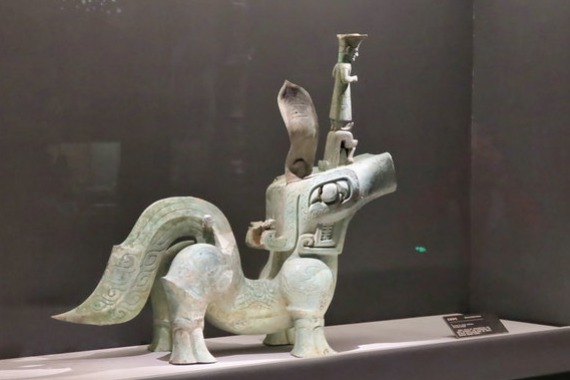
Another bronze statue, with the body of a dragon, head of a tiger, and a bird resting on the base, also arouses curiosity about its use.
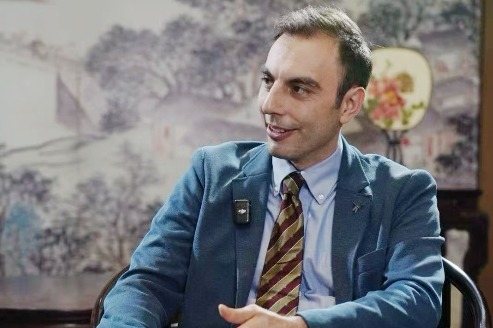
"Visitors can develop their own explanations," Gao says. "They may even inspire our own studies, as well."
Yu Jian, deputy director of the Sanxingdui Museum, says the ongoing exhibition displays the new mindset toward artifact restoration, as even damaged items can convey a great deal of information.
Despite their initially strange appearance, the Shu artifacts also demonstrate close links and frequent interaction with other regions in the rest of modern-day China, particularly in the middle and lower reaches of the Yangtze River, Gao says.
For example, a jade cong, a square tube with a circular bore, is typical of both Sanxingdui and Jinsha, but can be traced back to the Liangzhu Culture, which existed 5,300 to 4,300 years ago in modern-day Zhejiang province, nearly 2,000 kilometers away. Some bronze vessels from the sites also feature elements typical of the central Shang Dynasty (16th century-11th century BC).
"They provide significant evidence for a profound understanding of the diverse and integrated origins and development of Chinese civilization," Gao says.
"Regarding Sanxingdui and Jinsha, what moves us so deeply is not only the beauty, awe and mystery of the objects, but also the people themselves and their rich expression of self through materials like bronze, gold and jade," he says. "This expression embodies the commonality of the era and the individuality of regional culture blending tradition with innovation."
The Beijing event is the third major exhibition of recently excavated artifacts from Sanxingdui outside its home, after exhibitions in Hong Kong and Shanghai. It also lifts the curtain on a series of exhibitions tracing early-stage Chinese civilizations at the Capital Museum.