


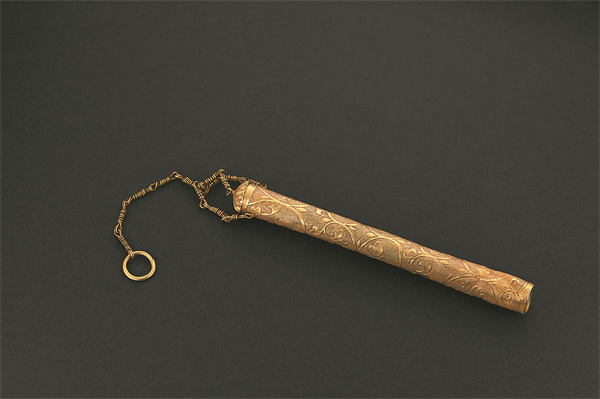
In fact, the Song-Liao conflict dominated the narrative of Chinese history in such a way that many viewers of the current exhibition are taken aback by the abundance of material evidence pointing to the level of exchange between the two sides.
Among them are celadon wares from the famed Yue Kilns in eastern China, which fell within the Northern Song borders. A celadon tea set comprising a cup and a saucer — both with their edges coated in silver for enhancement — tells the story of how it had once been treasured by the owner, a royal concubine of a Liao emperor who, unsurprisingly, was surnamed Xiao.
Acculturation — that is what happened according to the curator, who believes that close contact with the central dynasties of China had led to a partial adoption by the Khitans of not only the former's way of life, tea-drinking for example, but also their set of values embedded in Confucianism.
This was especially true when it came to women. In the mid-1990s, a stone burial chamber of an aristocratic Khitan lady was discovered in Chifeng city of Inner Mongolia, dating to the early period of the Liao Dynasty.
"It's undoubtedly a deliberate choice that both the chamber's northern and southern walls were painted on the inside with stories centered on women from Chinese history," says Xu.
On the northern wall, Tang Dynasty's most eminent royal concubine Yang Yuhuan was pondering over some Buddhist scriptures, looked on by her pet parrot. Facing the scene is another mural inspired by a woman named Su Hui who lived half a millennium earlier in fourth-century China, a time of great division and tumult. Pining over the absence of her husband, who had been dispatched to the faraway desert land in modern-day western China, Su, equally adept with a writing brush and a loom, weaved a poem of her own into a piece of brocaded cloth she later sent to her loved one.
"Both were likely to be popular themes during the Liao time, celebrating women as much for their devoutness and loyalty as for their own accomplishments, literary or otherwise," says Xu.
"Given the pastoral tradition of Liao and its recurring wars with their neighbors, it's not unusual for a Khitan husband to be away from home for extended periods of time. Keeping that in mind, Su's story probably struck more than a few chords."





