



Mexico City faces 'Day Zero'
Latin American country's capital in crisis mode as it may run out of water by end-June









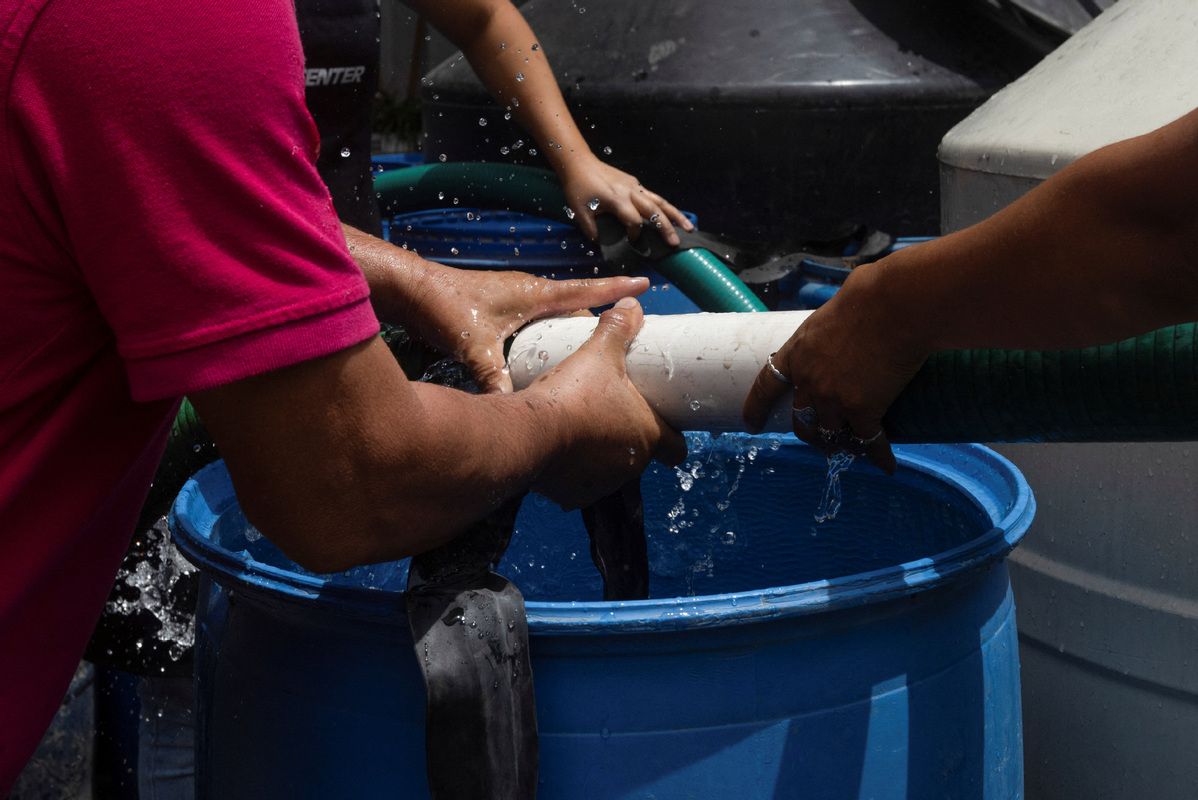
Mexico City seems to be quickly approaching a critical milestone that experts call "Day Zero" – when the city could run out of water – by the end of June.
This alarming scenario is becoming increasingly likely after three years of drought and hot weather, which have all but dried up the city's Cutzamala water system that services about 22 million people and currently runs at 28 percent capacity.
"Many years ago, Mexico City began to suffer from water-scarcity issues. This is due to a combination of several factors that all point in the same direction and contribute to this problem," Adrian Fernandez Bremauntz, executive director of the Mexico Climate Initiative, a think tank, told China Daily.
Bremauntz said the water-scarcity problem that Mexico City faces is complex. The city's traditional overreliance on underground water has combined with diminishing rainfall, widespread deforestation and a heat wave.
"First, more water has been extracted from the subsoil than is recharged into aquifers. We are already drying up all the underground water in the Valley of Mexico," Bremauntz said.
"Another factor is that it has been raining less and less in the entire central area of the country. A third factor is the deforestation of forests … throughout central Mexico and other places."
The city's water crisis has been compounded by a four-year drought that has drastically cut down water levels in the Lerma-Cutzamala system's dams, forcing more frequent supply cuts and increasing the reliance on bottled water.
"Therefore, the sum of three major factors is the problem (we face now): one, less precipitation over the years; two, the little water that falls runs off and (does not recharge) the aquifers; and three, we are extracting more from the subsoil than is naturally recharged," Bremauntz said.
Climate change, which has led to record heat waves throughout Latin America, has exacerbated the situation by increasing the evaporation rates of existing water, which puts more stress on Mexico City's water system.
The North American Drought Monitor on April 30, which said conditions in Mexico City are "severe"; local authorities estimated that Day Zero could happen as early as June 26 if it does not rain.
The city faces an urgent situation, with leaky pipes and weak infrastructure making the situation worse as what little water is available is wasted.
Heliodoro Ochoa Garcia, a professor at ITESO Universidad Jesuita de Guadalajara, Mexico, said the problem is complex and cannot be easily solved.
There are three interrelated factors that must be addressed, which include water flows, technology and infrastructure, and norms and institutions.
"These three factors offer us a perspective that (help to understand) the complexity and articulation that exists among various water-related issues, their challenges, and possible solutions," Garcia said.
Human activities such as overextraction, contamination and changes to land use have significantly altered natural water flows, contributing to the current crisis.
A critical part of any solution will involve learning from other cities that have navigated similar challenges, such as Shanghai, Tokyo and Sao Paulo.
For example, Sao Paulo faced a severe water crisis in 2015 but managed to recover through a combination of stringent water-use regulations, infrastructure improvements, and public awareness campaigns.
Shanghai, in turn, has been steadily improving its water infrastructure since the late 1980s, when it launched a $153 million water sewage project.
For the past decade, Shanghai has been implementing a "sponge city" concept and implementing infrastructure development.
"The first thing that needs to be done is (based on) common sense: proper resource management, efficient management, not wasting water. It has been known for a long time that more than 40 percent of all the water that reaches Mexico City, brought from hydrological basins several hundred kilometers away, is wasted (due to) leaks," Bremauntz, at the Mexico Climate Initiative, said.
"The norms and institutions involved in water management need to be adjusted to current realities with a focus on distributive justice that considers the unpredictability of climate change and the increasing conflicts over water access," said Garcia at ITESO Universidad Jesuita de Guadalajara. "Privatizing water and water service infrastructures does not seem to be the best solution."
It will also be important for the authorities to protect vulnerable populations. During heat waves, older people are particularly at risk of dehydration, cardiac failure and other health complications.
The writer is a freelance journalist for China Daily.










