


Finding time
Cayol says her over 20 years in Beijing have taught her a lot about time, in her own life and across cultures.
"I've had an incredible time in China. This can be summarized with one single topic, which is time," she says.
This prompted her to publish the book, Shijian Lide Zhongguoren, in French and Chinese. The English title translates from Chinese as "Chinese in Time" and from French as, "Why Do the Chinese Have Time".
"It's also a symbol of a very huge civilization. Chinese have a very specific relationship with time — much more flexible, much more, I'd say, friendly with time," she says.
"This kind of flexibility is not always so easy for foreigners and especially for Europeans. Sometimes, something is very sudden, and you stop — but now I'm very used to this very flexible way of dealing with time."
Cayol points out Chinese people can be "very rapid" in some contexts and "very slow" in others.
"And when we French are rapid, Chinese are slow. And the opposite — when Chinese are slow, we are rapid … Like tea, you have to infuse a lot of time and to wait, and to wait and to wait."
Her time living in China has also enabled her to learn that tea can teach us about life and time, she says.
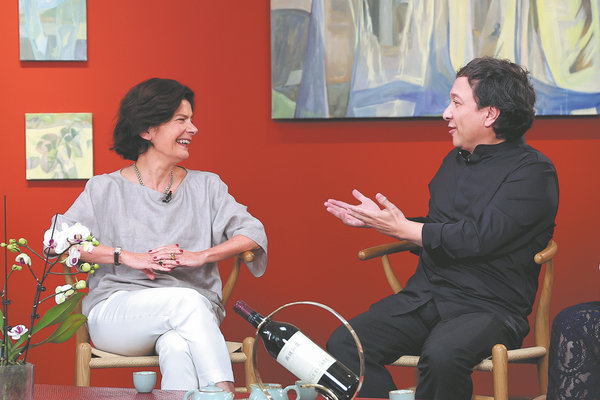
She explored these realizations by hosting an exhibition a decade ago featuring a dialogue between Chinese tea and French wine.
"There are many similar approaches. You take time, you discover a lot of things through tea, like through music, like through painting. It's a never-ending process to know more, to have more images in your mind. So, for me, it's a very, very sophisticated way to enjoy life."
Cayol ultimately believes the entire enterprise of cross-cultural engagement is about taking and making time.
"When I came to China, I didn't know anything about Chinese literature. But my choice has been to dedicate time — and deep time — to learn about some Chinese spirituality, Chinese literature, Chinese music, to take this time to study. So, about boundaries, this is a fact that if you're crossing over these boundaries, there are no boundaries anymore," she says.
"But it's a process. It's not immediately, 'OK, I go to China, I go to France, I go to America, and I have this feeling already that there are no boundaries anymore'. There are. There are a lot of differences between us."
These are surmountable, Cayol says, given time.
"The idea, what's very important to me from a philosophical point of view, is to get into this process, to not avoid these differences, these boundaries, but to go beyond," she says.
"But it's not that easy. You need time. You need a strong will. And you need to feel confident about your own culture to be able to go beyond your own culture."





