


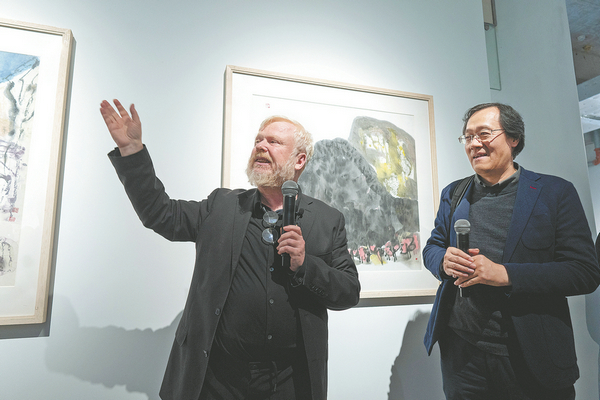
"It was, for me, a change of life. I came from France, but China gave me the biggest present — that is, the courage to create. It allowed me to find a way of immersing myself in another culture, philosophy and in another art practice," he says.
Vermander has visited many places across China over the past three decades, including Sichuan province in Southwest China, where he studied Chinese painting and met his mentor and closest friend, painter Li Jinyuan.
Vermander says that Li asked him to draw subjects from his childhood in France, because his memories would not be the same.
"He gave me pencils and paper and asked me to quickly draw the memories of my childhood. And when I had done that, he said he respected who I am, my past, my sensitivity, and he showed me how to express them with ink according to the method of Chinese painting."
This may also explain the integration of Western and Chinese painting styles in Vermander's works.
Shen Yubing, another professor at the university's School of Philosophy, says that the Chinese ink paintings at the exhibition reflect the influences of Western painters, such as Henri Matisse (1869-1954) and Paul Cezanne (1839-1906), as well as of Chinese elements such as folk arts.
Vermander's research focuses on Chinese religions. He is committed to interpreting Chinese classics to promote cultural exchange between China and the West. Although philosophy and Chinese ink painting might seem disparate at first glance, Vermander says that they are actually closely connected.
"Philosophy is not about data or information but about thinking. You have to be able to confront yourself, to look at yourself and go into yourself. Thinking about problems, especially philosophical problems, is not the work of the brain but involves the participation of the whole being, including your creativity, physical experiences, senses, imagination, emotions and bodily feelings," he says.
"Every one of my Chinese ink paintings is also a philosophical article."
He adds that a good work — of either art or philosophy — should allow diversity in meaning, as each one can have a different connection to his work.
Vermander says that he regards his paintings as integrated expressions of himself with daily life. Through the ink brush, he hopes to freely show his inner explorations, dynamics and the movement of his heart.
"What I like most in Chinese ink painting is the dynamism, mobility and freedom it allows you. I am not skilled in Western painting as I have bad eyes, and it is not my character to be cautious, careful and plan everything. With Chinese calligraphy and ink painting, I could liberate my inner wildness. My only future goal is to have more time for writing and painting — that's it," he says, laughing.
Contact the writer at wangxin2@chinadaily.com.cn





