


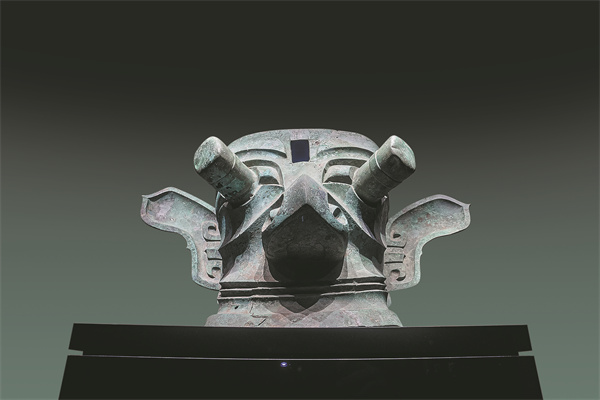
"Fusion — that is the key word for Sanxingdui," Hu says.
Wearing a fancifully adorned tall hat and elephant tusk-shaped ear decorations, the bronze figure is holding a dragon-form scepter which seems to echo another dragon winding down from the cover of the bronze zun under the man's feet. If the dragons, for all the creature's cultural connotations, stand as irrefutable proof to Sanxingdui's integration into the Chinese civilization, then the incorporation of the two bronze vessels into the design has shed tantalizing light into the process of that integration.
"Zun and lei, the two main types of bronze vessels found at Sanxingdui, were also among the most prevalent forms of ritual bronze for the lower reaches of the Yangtze River during that time," says Hu. "Researchers are still divided as to whether these bronzes had arrived at Sanxingdui by trade, or were brought there by immigrants via the waterway. But, one thing is for sure, they were embraced and prized so much so that they were, literally, melded with the local culture and religion."
According to the curator, although looking almost exactly the same as their counterparts that were discovered downstream, the bronze vessels from Sanxingdui sometimes feature drilled holes, which allowed them to be joined with locally made parts, bronze figures of men and animals for example.
In one case, a bronze zun was welded onto the head of a bronze man in a kneeling position, a process that had obliterated part of the pattern on the vessel's bottom.
"The same process had also subjected the culture of Sanxingdui to the far-reaching influence of China's Shang Dynasty (c. 16th century-11th century BC), whose time span coincided with that of what's known today as the Sanxingdui civilization," says Hu.
"Through unbridled imagination and sheer willfulness, the Sanxingdui people had added a spoonful of their own ingredients to the potent cultural mixture they had adopted and adapted," says the curator. "The latter was done with great panache, to fantastical effect."





