Travel route honors CPC's historic journey









A new travel route featuring red cultural heritage was issued in memory of a historic event 75 years ago, the Beijing Municipal Cultural Heritage Bureau and Hebei Provincial Cultural Heritage Bureau announced at a ceremony in the capital in March.
The route dates back to March 1949, when the leadership of the Communist Party of China, under the guidance of Mao Zedong, departed from what is now Xibaipo village in Shijiazhuang, Hebei province — a former command center for China's revolution. Their destination was Beijing, where they took up residence at Xiangshan Mountain (or the Fragrant Hills) to oversee the military campaign that ultimately led to the downfall of the Kuomintang regime.
It was in October of the same year that the People's Republic of China was founded.
Mao likened this significant journey from Xibaipo to Beijing to "going to the capital for the big exam", making reference to the imperial examination system of ancient China. This demonstrated the leaders' determination in facing new challenges.
The newly designated route, designed to commemorate this historic journey, connects various sites along the road from Xibaipo to Xiangshan Mountain, including Shulyu village in Tangxian county and Zhuozhou Railway Station in Hebei, as well as Qinghuayuan Railway Station, the Hall of Increasing Longevity at the Summer Palace, and Shuangqing Villa in Beijing.
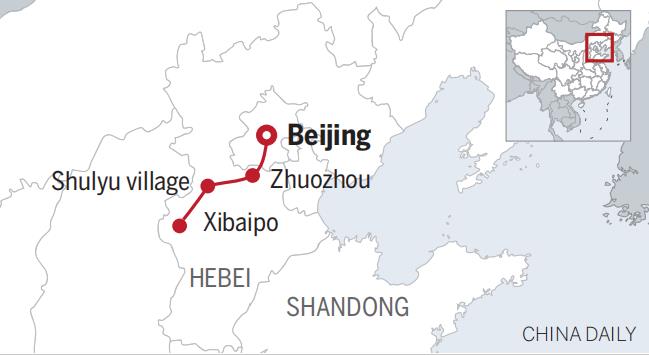
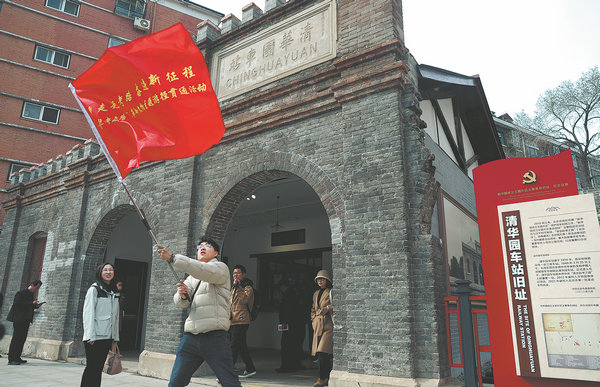
Chen Jiayi, a tourist guide at Qinghuayuan Railway Station, recounts that the CPC leadership departed from Xibaipo on March 23, making a stop in Shulyu village, where Mao engaged in discussions with residents. They then boarded a train at Zhuozhou Railway Station, arriving at Qinghuayuan Railway Station in Beijing on March 25. Subsequently, they proceeded to the Summer Palace for rest, and later reviewed troops at Xiyuan Airport before settling at Shuangqing Villa on Xiangshan Mountain in the western outskirts of the city.
Chen Mingjie, head of the Beijing Municipal Cultural Heritage Bureau, says: "Through field visits, we will come to understand the challenges our predecessors faced in their struggles, thereby strengthening our resolve to uphold their spirit and continue to strive for a new era."
Among the sites, Qinghuayuan Railway Station holds particular significance as the first station where the CPC leadership arrived in Beijing and then transferred to the Summer Palace, as noted by Chen Jiayi.
The station was on the Beijing-Zhangjiakou Railway, which holds the distinction of being the first railway exclusively designed and constructed by Chinese engineers. The railway, envisioned by Zhan Tianyou, an esteemed engineer revered as the "father of China's railway", commenced construction in 1905 and was completed four years later during the late Qing Dynasty (1644-1911), culminating in the establishment of the Qinghuayuan station.
An exhibit at the station showcases a segment of the original steel rail utilized on the Beijing-Zhangjiakou Railway. "The rail bears inscriptions indicating its purchase from a French company by the Imperial Chinese Railway in 1905," says Chen Jiayi.
"This station played a crucial role in the journey of the CPC leadership to Beijing, marking a significant shift in the heart of China's revolution from rural to urban settings, and representing the historic moment when CPC members entered Beijing."
During the ceremony in March, an initiative focusing on the preservation of cultural relics associated with the "going to the capital for the big exam" event was unveiled. The initiative emphasizes the need for enhanced protection and scholarly exploration of cultural heritage, the establishment of coordination mechanisms for safeguarding such relics, their revitalization, and their integration with tourism to spur future development.