



Visit proves strength of shared heritage









In 2021, The Economist labeled the Taiwan Strait as the "most dangerous place on Earth" in its cover headline.
In an era of information overload, misinformation and disinformation make it hard for the general public to discern the truth, and many people, even some well-informed people, believed that there might be great difficulty in reaching reconciliation across the Strait.
However, I found The Economist to be totally wrong when I heard a group of university students from both sides of the Strait performing a medley of popular songs from both sides.
This scene took place last week at Sun Yat-sen University in Guangzhou, Guangdong province, where Ma Ying-jeou, the former chairman of the Chinese Kuomintang party, and 20 young people from Taiwan attended a fellowship activity with students from the university.
During their 11-day trip to the Chinese mainland, they visited the provinces of Guangdong and Shaanxi as well as Beijing, explored historical sites and high-tech companies, and participated in a ceremony paying tribute to Emperor Huangdi, or the Yellow Emperor, the legendary common ancestor of all Chinese people.
These students from Taiwan also visited Peking University in Beijing on Tuesday to engage in exchanges and interactions with the faculty and students.
These students in their 20s crossed the so-called "most dangerous place on Earth" to meet each other, sing and dance together and recite poetry.
The laughter of those college students and their rhythmic movements to the music cannot lie — they had fun together, touched by each other's sincerity and kindness, despite coming from areas with different political systems and societal landscapes.

As a journalist accompanying the whole mainland visit, that was one of the most touching moments for me.
Of course, there were many more moving moments during the trip.
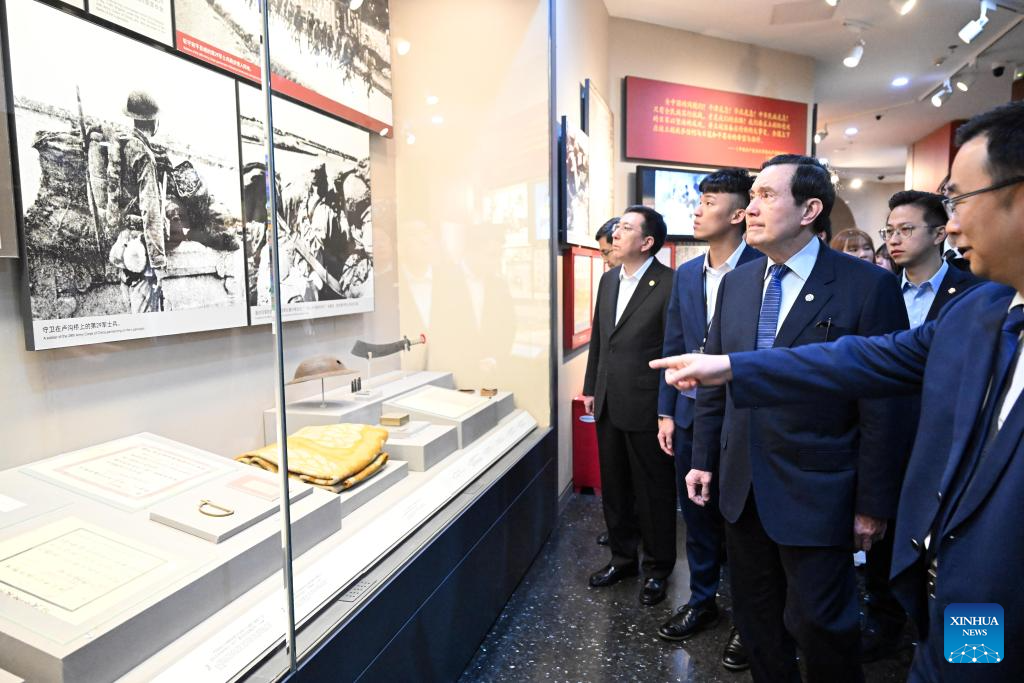
A member of the Taiwan youth delegation, who visited the mainland for the first time, told me that the most memorable moment was visiting the Museum of the War of Chinese People's Resistance Against Japanese Aggression near the Lugou Bridge in Beijing, where the delegation engaged in a conversation with Zheng Fulai, a 93-year-old witness of the Lugou Bridge Incident in 1937.
He said the visit made him feel "excited yet sad", and as if he had "touched history".
Lugou Bridge is where Japanese forces used a pretext to launch an attack. The incident is recognized as the start of Japan's full-scale invasion and China's full-nation resistance against the invaders.
The young man's grandparents came from the mainland, and his great-grandfather was a captain during the war, and sacrificed a lot.
"I felt as if the stories my grandparents told were unfolding before my eyes; the bridge that was trampled by Japanese invaders over 70 years ago was right beneath my feet," he said. "These were experiences I could never have in Taiwan."
At Lugou Bridge, the 93-year-old Zheng held Ma's hand tightly, sharing with the Taiwan youths the hardships the Chinese people endured during the war.
I could see clearly that everyone on that historic stone bridge was deeply moved.
This trip raised a crucial question: If a shared history of hardship could unite the Chinese people in the past, why can't it inspire a brighter future together?
The cultural resonance felt by the Taiwan youth delegation in Shaanxi, where they explored the Terracotta Warriors, reinforced this. As Liu Ping-jui, head of the delegation, noted, "We are touched by the wisdom passed down by our ancestors, who left us such profound cultural heritage."
The path forward may be complex, but this exchange across the Strait offers a beacon of hope.
Shared experiences and a common cultural heritage can bridge divides. The laughter of students and the shared reverence for history offer a more hopeful narrative than headlines about tension.
While challenges remain, this exchange across the Strait is a testament to the enduring power of shared humanity. It's a story worth remembering, one that moves beyond the headlines.


- Senior enterprise official facing probe
- China's anti-graft authorities reveal extent of year's work
- Former Haikou Party chief gets death sentence with reprieve
- Purchase of US-made weapons to push Taiwan closer to the peril of war: spokesman
- WIC calls for submission of cultural heritage digitalization cases
- China calls for global opposition to Japanese neo-militarism









