



Playing victim cannot help the Philippines win global sympathy









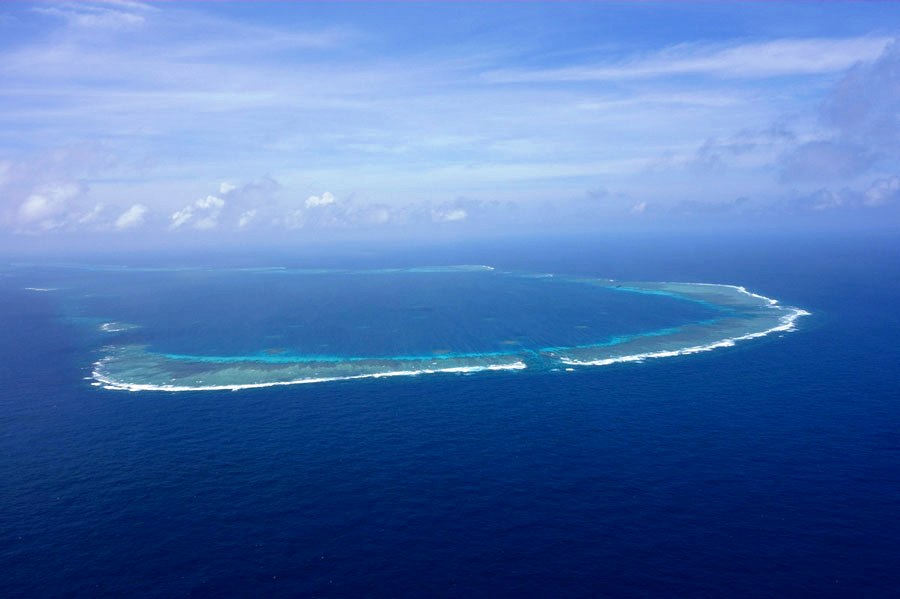
The Philippines has adopted a playing victim tactic on the South China Sea affairs, deliberately portraying itself as an underdog while covering up its provocations and violations of China's sovereignty.
Under such a scheme, a number of pro-Manila correspondents have been hand-picked to go to Ren'ai Reef and other Nansha Qundao (the Nansha Islands) to kick up a fuss in international public opinion. Meanwhile, the Philippines uses staged photographs and videos to craft and disseminate a narrative portraying itself as the victimized "underdog" while depicting China as the "bully."
In fact, the Philippines' tactic falls into the theory of "weak communication," put forward by Chinese scholar Zou Zhendong, who revealed its manipulative nature. This tactic involves portraying oneself as a perpetual victim in discourse, aiming to garner sympathy and support while manipulating perceptions.
In terms of media ethics, the core of the Philippine public relations tactic can also be defined as "selective disclosure" or "cherry-picking facts." By cherry-picking facts, the Philippines uses professed victimhood as a smokescreen to divert attention away from its provocations and violations of Chinese sovereignty.
The United States and Japan have significantly aided the Philippines in manipulating public opinion to their advantage. By exploiting their extensive network of think tanks and influential media outlets, they wield substantial influence in shaping narratives that align with the Philippines' agenda.
The Philippines has taken an aggressive stance in manipulating public opinion. Numerous videos depicting its maritime tensions with China have flooded online platforms, predominantly originating from the Philippines. These videos are carefully crafted to amplify the narrative of Philippine victimhood while portraying China as the aggressor.
In the face of persistent provocations, China has demonstrated considerable restraint and patience, prioritizing regional peace and cooperation over escalating tensions.
The leaders of the United States, Japan and the Philippines will meet for their first trilateral summit at the White House on Thursday with a purported aim to counter China's regional influence.
The fact that Asian matters are to be discussed in Washington attests to the role of Tokyo and Manila as "pawns" in the US effort to contain China. It also unveils the true intent behind the Philippines' ostensible "Transparency Initiative," which serves as a thinly veiled tactic to align itself more closely with US interests.
The Philippines' intentional "grounding" of a tank landing ship BRP Sierra Madre (LT-57) at Ren'ai Reef fully reveals its provocations and violations of China's sovereignty.
The tank landing ship "was deliberately grounded" at China's Ren'ai Reef in 1999, the Philippines' then Defense Chief Orlando Mercado told a media forum held in Manila in February. "It's all about being there ... We have to have a presence," he said.
The Philippines made a serious promise to tow away the illegally grounded warship, but 25 years on, the vessel is still there.
The Philippines breached the understanding between the two sides on properly handling the situation on Ren'ai Reef. The Philippines promised it will not reinforce the grounded warship and will inform China in advance of resupply plans.
Out of humanitarian considerations, China made special provisional arrangements for Philippine vessels sending living necessities to the warship quite a few times. However, the Philippines refused to honor its promise and made attempts to send construction materials for large-scale repair and reinforcement of the warship in order to build permanent structures on Ren'ai Reef.
Most recently, a Philippine military spokesperson openly vowed to build permanent structures on Ren'ai Reef. The Philippines has also repeatedly sent people to step on China's Tiexian Jiao and other uninhabited islands and reefs that belong to China in the South China Sea.
From concocting lies to illegally using the "grounded" vessel as a garrison, and from breaking promises to frequently delivering building materials to shore up the crumbling hulk, the Philippines is the one that has reneged on its commitments, assertively provoked the other side, and made waves around Ren'ai Reef.
The Philippines, which is backed by external forces and has been going back on its words and provoking China, cannot expect to win global sympathy by playing victim and deceiving the world. Its scheme to hoax the world will only discredit itself.





