



Reform unlocks Xizang's economic potential









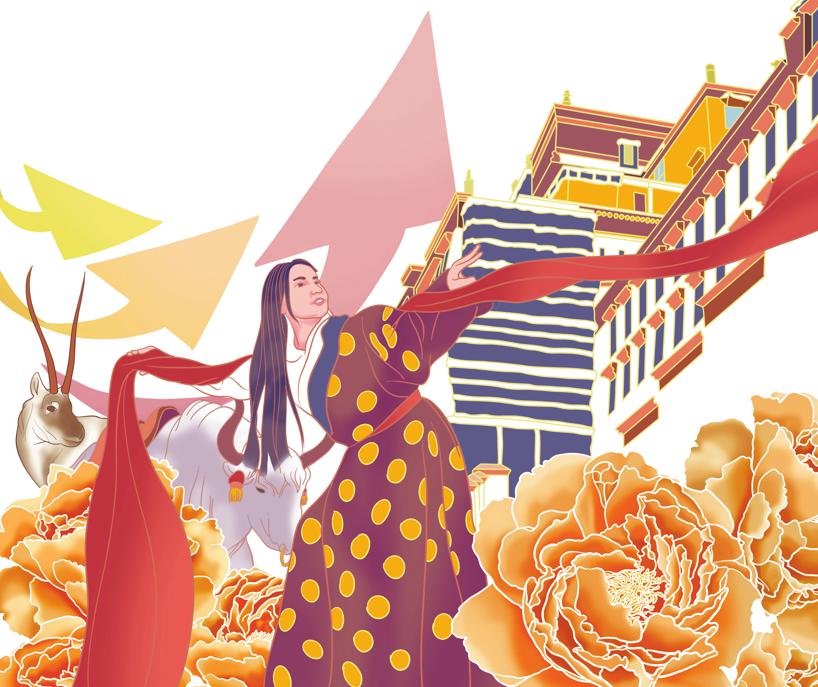
For centuries, Xizang has made exemplary economic and social progress every time it has taken measures to fully integrate into the national economic and social structure. From the arrival of Princess Wencheng, who brought with her a wealth of knowledge and technology from the Tang Dynasty (618-907) to Tibet to the peaceful liberation of Tibet in 1951 and the subsequent abolition of the feudal serfdom in 1959, to the present times, the Xizang autonomous region, which was founded in 1965, has undergone profound transformations and seen unprecedented economic development.
In the period between the First Opium War in (1840-42) and the founding of the People's Republic of China in 1949, China lost its position as a global economic leader as it turned into a semi-colonial and semi-feudal state. Tibet, being under an archaic feudal system, was in an even worse position.
At the time of its peaceful liberation in 1951, Tibet lacked modern infrastructure, schools and industry. Tibet didn't have a single modern road, a single school in the modern sense of the term, nor did it have any form of modern industry. Virtually, modern education, healthcare, commerce and technology were nonexistent in Tibet.
The only semblance of modern civilization was a 92-kilowatt hydropower station, which operated sporadically and supplied electricity exclusively to a privileged few among the ruling elite. It is the democratic reform that facilitated the region's comprehensive leap forward, improving its economy, income levels, infrastructure and social governance far beyond that of its neighboring regions.
The ultimate goal and measure of socioeconomic development lie in the liberation and advancement of its people. The emancipation of more than 1 million serfs in Tibet marked a historic leap forward in the history of human rights protection and promotion. The democratic reform in Tibet, which ended serfdom, signifies China's commitment to protecting and promoting human rights.
Unlike many other countries, China moved away from a social structure that was dominated by slave- or serf-owners and established a society based on equality and competition, which created opportunities for talented individuals to climb up the social ladder irrespective of their familial background. This is a unique feature of Chinese society.
However, old Tibet, influenced by its natural environment and Indian religious traditions, adopted a socioeconomic structure with strong elements of the Indian caste system. A privileged few controlled everything, leaving the majority of the people in Tibet, primarily serfs, bereft of even the basic rights and freedoms. Only through the hard work of the central government did Tibet break free from the shackles of poverty and backwardness, and the Tibetan people achieve emancipation.
From the Authorized Regulations for the Better Governing of Tibet promulgated in 1793 to the liberation of over 1 million serfs, history shows Tibet's integration into the mainstream Chinese governance system is the only way it can achieve progress. In this regard, socialism, inherently focused on liberating and developing productive forces, has significantly contributed to modern Xizang's economic development since the region's liberation and the launch of democratic reform.
In 1951, prior to the launch of democratic reform, the GDP of Tibet, which had a population of 1.14 million, was a mere 129 million yuan ($17.88 million). By 1958, Tibet's GDP had increased by 33.3 percent to 172 million yuan, largely due to the influx of troops, central officials and technical workers into the region. The launch of the democratic reform in 1959 saw the region's GDP surge by 46.6 percent to 255 million yuan in 1960.
By 2023, Xizang's GDP had soared to 239.27 billion yuan. Xizang's economic and social development now dwarfs some neighbors. Xizang has witnessed unprecedented growth and prosperity — a far cry from its previous state of deprivation. The condition that old Tibet was even much more backward than India has totally changed.
The rapid development fueled by China's economic miracle has lifted Xizang's average income and living standards above those of neighboring countries. In 2022, the per capita GDP of Xizang was 58,438 yuan (about $8,688), approximately 3.63 times the per capita GDP of India in the same year ($2,392).
Such achievements have left even Indian influencers shocked, as evidenced by the overwhelming response to videos showcasing the splendor of Xizang. As China's economy and society continue to progress, Xizang's future will undoubtedly be brighter.
The author is a researcher at the Chinese Academy of International Trade and Economic Cooperation.
The views don't necessarily reflect those of China Daily.
If you have a specific expertise, or would like to share your thought about our stories, then send us your writings at opinion@chinadaily.com.cn, and comment@chinadaily.com.cn.





