


China's most cherished creature










Shang artifacts also show the tendency toward dragon patterns becoming increasingly elaborate, paired with other elements, such as clouds, flowers and water. Dragons were often depicted crawling, curling and surrounded by circling patterns, and sometimes with a head on both ends, or two or more dragons together.
Over time, objects decorated with dragons, sometimes also functional, were created as objects of beauty. Examples on display include a bronze iron dated to the Han Dynasty (206 BC-AD 220), which consists of two parts; a bowl to contain burning coal and a long handle, the end of which is a dragon's head. It is believed to have been used as an instrument of torture during the Shang Dynasty, and was later used to iron cloth during the Han Dynasty.
Some other objects at the exhibition witness the exchange and fusion between different ethnic groups. One vivid example is a green ceramic flask from the Liao Dynasty (916-1125) that shows two circling dragons flying above clouds.
The earthenware flask was styled after the leather bags commonly used by the nomads known as the Khitan, who founded the Liao Dynasty. The Khitan learned ceramic techniques from the Han during the 10th century, and made the leather bag-shaped flasks to store water, milk and other liquids. The style is also known as a saddle pot, or a chicken crest pot, after the unique shape of its mouth.
The flask has two holes in its top to put a string through, making it convenient to carry on horseback.
Later, as the Khitan shifted from the nomadic to the settled life, the holes were replaced by a hooked handle and the flask bottoms were flattened so that they could stand upright, but the leather bag shape was retained not only because it looked special, but also out of nostalgia for the carefree nomadic life.
According to Zhuge Yingliang, the exhibition's curator, visitors will see the evolution of the dragon over the long course of history. For example, depictions of it were bold and simple in the Tang Dynasty (618-907) and before, and later became more refined.
"The exhibition also shows the role of the dragon to different social groups. It symbolized imperial authority and also embodied the auspicious wishes of ordinary people," she says.
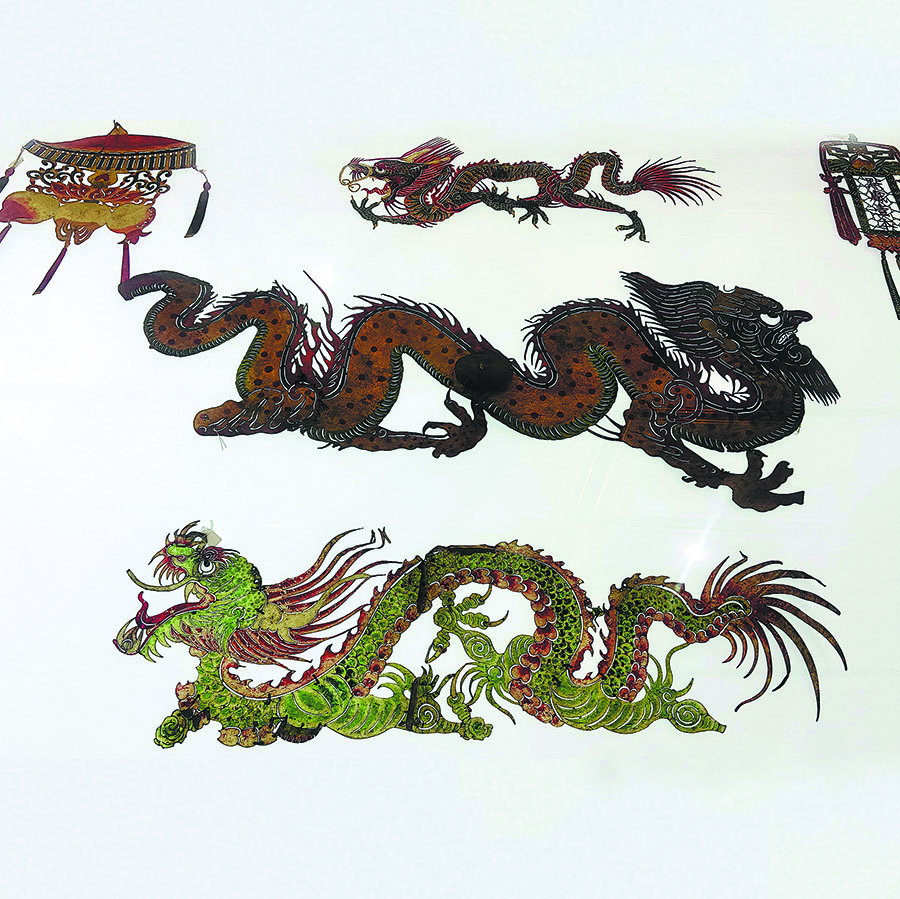
The show ends with a section of folk handicraft dragons, including shadow puppets, toys and embroidered pieces that were collected across the country by the Central Academy of Fine Arts.
"Ultimately, the dragon has become a collective embodiment of prosperity and peace, union and harmony," Zhuge says.





