


Innovations breathe new life into millennium-old intangible cultural heritage










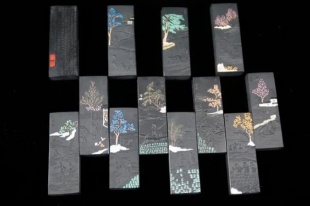
Featuring motifs ranging from lunar craters to Nintendo's retro games and Bruce Lee's iconic stance, the millennium-old Hui ink stick, an essential item in Chinese traditional painting and calligraphy, shines under the live-streaming spotlight, transcending antiquated perceptions and shattering the stereotype of being outdated.
Spearheading the evolution of this traditional Chinese stationery item is Xiang Song, 34, the fourth-generation heir of this craft, who has infused it with a contemporary twist.
These traditional Hui ink sticks are mainly crafted in East China's Anhui province, hence earning the moniker "Hui" ink, as the region was originally under the jurisdiction of Huizhou in ancient China.
The Hui ink sticks are primarily composed of the soot produced by burning pine trees or tung oil, with glue as the main ingredient, supplemented by various minerals and Chinese herbal ingredients in the formulation. It undergoes a meticulous crafting process involving dozens of steps.
Like many other traditional crafts embodying the essence of ancient Chinese culture, Hui ink-making faded into obscurity as the country progressed toward modernization.
However, with the burgeoning of social networks and live-streaming platforms, an increasing number of youths have turned their attention to traditional intangible cultural heritages and are integrating them with various modern elements. One such example is the Hui ink stick crafted by Xiang's family.
Some inheritors of the intangible cultural heritage in Xiang's hometown of Shexian county in Anhui province have also shifted towards developing products with a youthful appeal, utilizing the internet for marketing with notable success.
"Thanks to the internet, so many young people are now interested in Hui ink sticks. I plan to design unique products for them," Xiang said, pointing to his latest creation.
Boasting a wealth of intangible cultural heritage resources, this county is hailed as the "Hometown of Huizhou Culture," a distinctive regional culture imbued with traditional Chinese science and technology, education, opera and architecture.
The county is home to 170 representative intangible cultural heritage projects, including six at the national level and 24 at the provincial level.
In Shexian County, while preserving the core techniques and materials of intangible cultural heritage, innovating the appearance and sales channels of heritage products has emerged as a new approach for many inheritors.
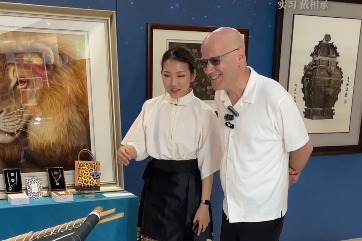
"This tea tray, cup holder and pendant are crafted using the She inkstone carving technique. More innovative heritage products are coming soon," said Cheng Lihui, a representative inheritor of the intangible cultural heritage of She inkstone carving, as he introduced the products to the livestream viewers.
According to Cheng, these creatively redesigned products not only come with more affordable prices but also offer practical value, greatly appealing to young people, especially when compared to traditional inkstones.
Cheng said he is very thankful for the advent and popularity of live-streaming. "In the past, many intangible cultural heritages struggled to capture the attention of the younger generation. However, through live-streaming, inheritors of intangible cultural heritage can engage directly with audiences, share their skills, and gather feedback to optimize product design," he added.
After improving product design, Cheng has sold products nationwide through online platforms, with one live-streaming event generating sales of over 300,000 yuan (about $42,295).
In addition to innovating production methods and expanding sales channels, in recent years, Shexian has integrated its unique intangible cultural heritage with rural tourism, utilizing online platforms to enhance both sectors.
In 2023, the county hosted 45 cultural tourism events, attracting over one million visitors and generating tourism revenue exceeding 320 million yuan.
"In the future, Shexian will continue to leverage the internet to develop more intangible cultural heritage digital products, and deepen the productization of intangible cultural heritages," said Wang Xiaojuan, deputy director of the culture, tourism and sports bureau of the county.