


Digging to discover the nation's roots










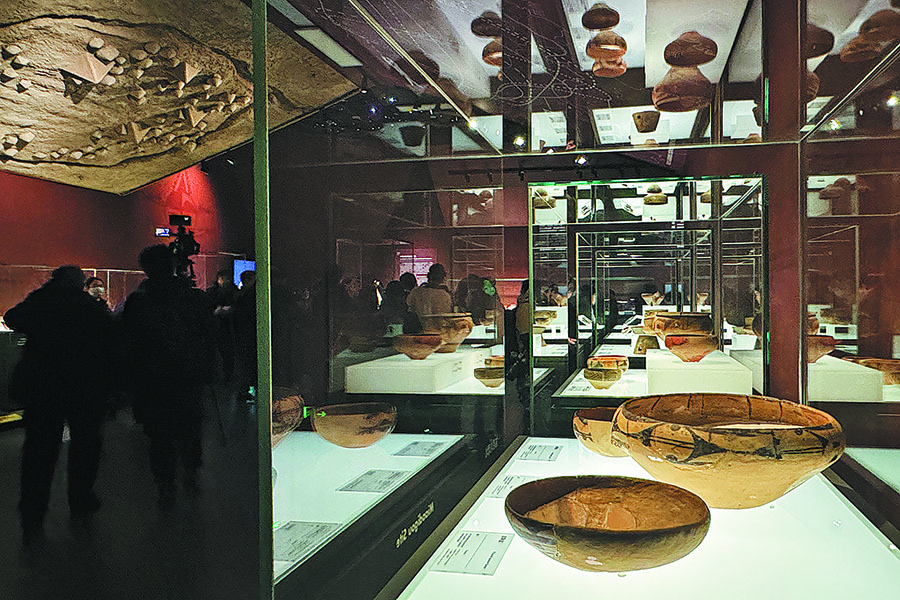
Liu expounded on some of the relics on display.
He says that the questions and concerns of the foreign journalists indicated their interest in the characteristics of Chinese civilization and its connection with other world civilizations, which coincides with the museum's goal of presenting the history of Chinese civilization based on physical evidence discovered through archaeological excavations.
Wang served as a chief expert from 2004 to 2016 on the project to trace the origins of Chinese civilization, which has proved that China's history includes a million years of hominin activity, 10,000 years of culture and more than 5,000 years of civilization.
The project, formally launched in 2004 and currently in its fifth phase, is dedicated to studying the development of Chinese civilization, its characteristics and causes, interactions between early regional cultures and how they were integrated into a diverse and unified Chinese civilization.
Upon beginning his lecture, Wang clarified his understanding of civilization.
"Civilization originates from social differentiation and its formation is marked by the emergence of a state," he says.
In particular, Wang argued that the three elements that Western scholars often take as the criteria for entry into a civilized society — metallurgy, writing and urbanization — are not universally applicable, as is seen in the cases of the Mayan and Incan civilizations — the Mayan people lacked metallurgy and the Incas didn't have a writing system.
"Different regions may have exhibited unique characteristics in their transition to a civilized society. Based on the archaeological evidence found in China, we can conclude a Chinese approach to identifying the crucial point of entry to a civilized society," Wang adds.
To put it simply, he says that entering civilization means the development of production, the increase in population, the emergence of cities, the intensified division of labor and social differentiation that leads to the emergence of social classes, the concentration of power and the emergence of kingship and states.





