Dying with dignity, living with love









A woman's experience of losing her mother and a cancer diagnosis launched a quest of understanding that ultimately inspired a journey to become a hospice volunteer and, consequently, an author, Yang Yang reports.
On July 6, 2019, 62-year-old Xu Shu came to the palliative care unit at Beijing Haidian Hospital, the Haidian Section of Peking University Third Hospital, as a volunteer photographer. She hesitated. She knew that on the hospice beds lay cancer patients who, with life expectancies of no more than six months, usually suffered from severe pain.
She knew how miserable they may look and sound.
Three years before, when her mother received chemotherapy, Xu heard the wailing of a terminal cancer patient at the same ward.
"It's so appalling. All the other patients became nervous when they heard the howling because that might also be their future," she recalls.
Her mom told her she'd rather die in a coma.
Xu's mother had lived with cancer for three years. But it was still hard for Xu to prepare for her unexpected death.
In her final days, her health deteriorated quickly. Xu didn't know what could be done at home. So, she sent her mom to the hospital.
It was a Sunday in mid-July. The ward's air conditioner was blowing cold blasts onto the bed to prevent cross infection. The nurse said nothing could be done about it.
The pharmacy didn't have opioids because it was the weekend. But Xu was still able to obtain transdermal patches that she thought could help her mother get through the night.
Before she drove her exhausted father home, she helped her mother lie down, covered her with a blanket and applied pain-relieving medicinal liquor on her dying purple toes. Her mom asked her to take good care of her father and said, "See you tomorrow".
Those were her last words.
Xu wanted to return to the hospital but was too tired. Thinking the nurses would attend to her mother, she fell asleep.
She returned early the next morning and was surprised to receive an official notice that her mother was in critical condition.
Xu rushed to her bedside. She found her mother couldn't move her facial muscles — and her hands were tied to the bed.
She asked her mom what had happened, but she could only move her head. A nurse explained "the patient" had been writhing in pain, so they'd secured her arms so she wouldn't disconnect the infusion tube. A night nurse had mistakenly peeled off the two transdermal patches, which no longer worked after they were reapplied.
"The pain was so intense that she had a stroke," she says.
Xu was devastated, thinking about how lonely, desperate and pain-stricken her mother was in that cold ward while she slept at home.
The hospital only allowed half-hour visits each day.
After the stroke, her mother was not able to say a word. And before Xu was ready, her mother died alone in the ICU.
When she rushed to the hospital, she found fluid was oozing from a hole in her mother's chest. But she recalled she'd told the doctor to not do any invasive procedures.
Xu was overcome with sorrow, regret, self-blame and despair. Half a year later, she was diagnosed with breast cancer.
She sent her father to an elder care center while she received treatment. And she and her husband spent the following year and a half traveling the world.
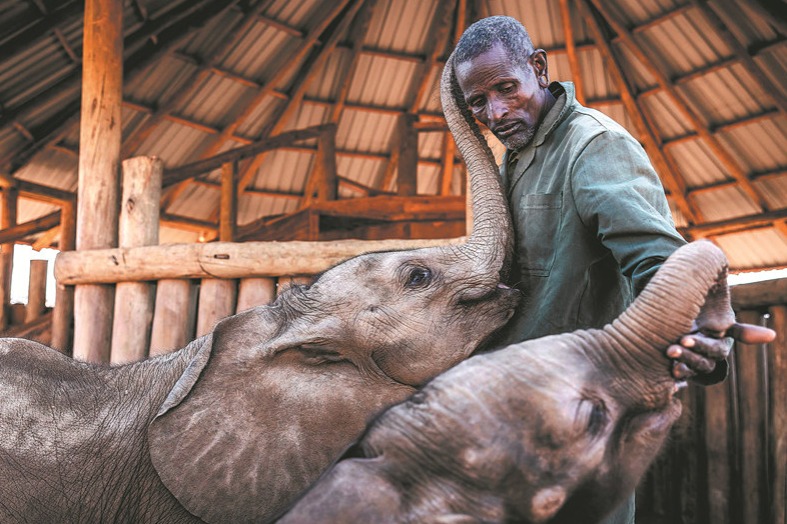
In Britain, she lay on a lawn outside a beautiful graveyard, where she found people appeared more relaxed when confronted with death. In Kenya, she saw beautiful wild animals and shot great memories with her camera.
But travel didn't allow her to entirely escape her sadness. She had to stop and contemplate her own death, "which is inevitable".
"If I wanted to continue traveling blithely, first, I needed to answer the question that kept coming to me: If my cancer progressed, where and how am I going to die? I don't want to undergo my mother's pain. I don't want to die at the hospital in lonely despair. I was wondering if there is any better way to die," she says.
"If, in the end, I get symptoms that can't be dealt with at home, where can I go to relieve the symptoms and die not so alone and helpless?"