Improving communication
Researchers help pioneer ways to enrich lives of visually impaired, An Baijie and Hou Chenchen report.









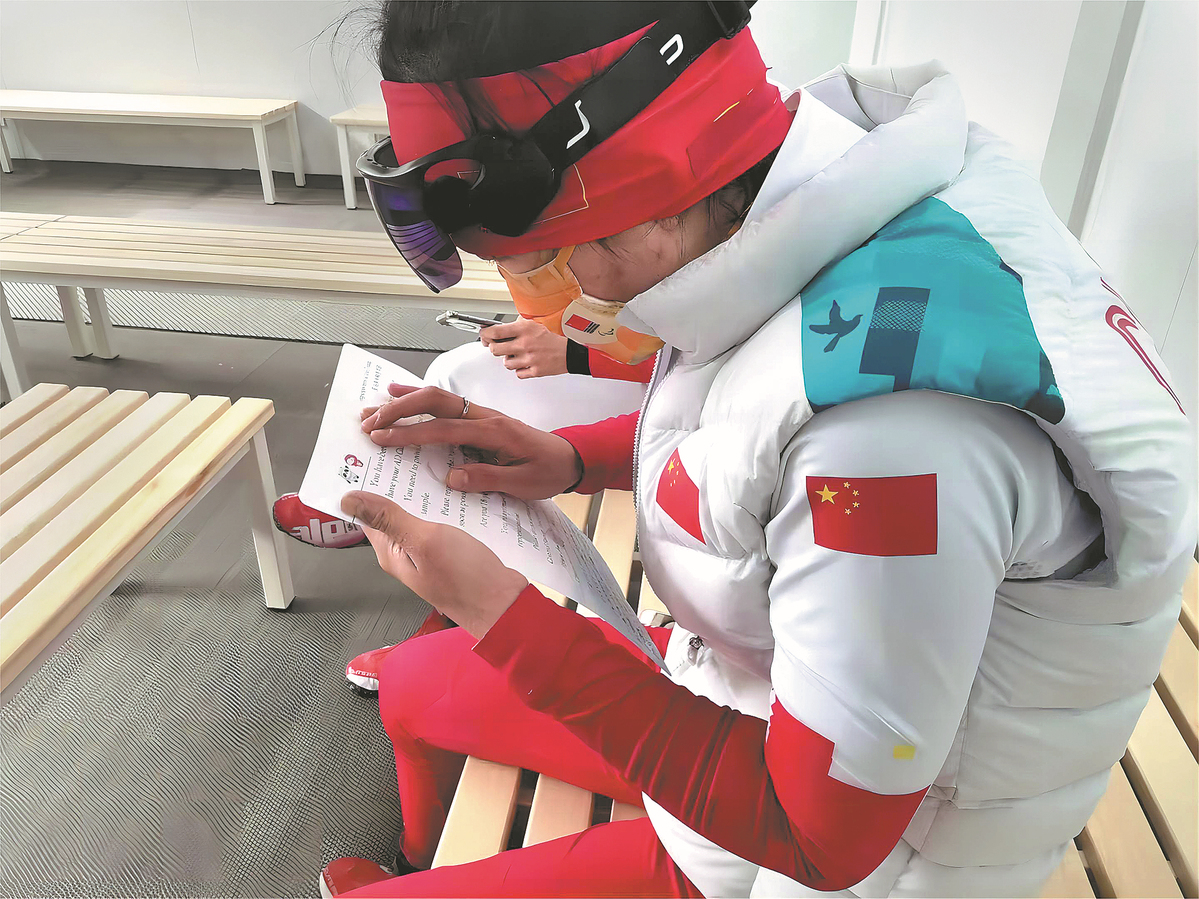
A Paralympic athlete reads the Braille guidebook in 2022.[Photo provided to China Daily]
Overcoming obstacles
The primary challenge in incorporating tones into Braille is to strike a balance between tone accuracy and conserving Braille cells. Any alterations to the Braille system must consider the reading habits of the visually impaired, Zhong says.
"To add tones isn't inherently complex; by introducing an additional six-dot Braille cell to denote tone after the initial and final consonant cells of each character, this can be achieved," he says.
"However, such an approach significantly increases cell amount and drastically slows down reading speed."
From 2007, Zhong started to explore ways to add tones into the Braille system without overturning the original system. In 2009, Zhong's project was launched and received national social science funding.
"Our new version should not overturn the original system; we should consider blind people's reading habits," he says.
Initially, Zhong planned to create a homophone corpus of Mandarin to annotate words in Braille. However, he later abandoned the strategy as it would pose a significant burden of memorization on visually impaired people.
To strike a balance between tone accuracy and conserving Braille cells, Zhong and his group endeavored to omit tone annotation based on tone number or syllables. But these methods did not align with the reading habits of visually impaired individuals, as revealed in their pilot study.
Recognizing the potential to omit annotations by considering the frequency of tone occurrences in the initial consonants of Chinese syllables, Zhong conducted a quantitative analysis of 10 million Mandarin Braille cells. This rigorous examination led Zhong to discover an effective method for incorporating tones into Braille in 2016.
China introduced its Chinese Common Braille Scheme in 2018 following a two-year trial period, marking an end to the 70 years of non-tonal Braille.
To gradually implement the common Braille scheme, textbooks used in schools for the visually impaired were progressively updated with the new scheme starting from the first grade. The common Braille system now encompasses all foundational education from the first to seventh grade in China.