


"Only a dozen people are learning to play it. I welcome anyone who wants to learn," he says, adding that, after the tradition has been passed down through the generations, he is afraid that it may disappear one day for lack of inheritors.
He knows the survival of Jingpo folk music depends on initiatives such as the oral tradition archival project.
For Rongbaxinna, it is not only a group's language or music, but also its culture, worldview, values and principles that inform future generations, and teach them about their past.
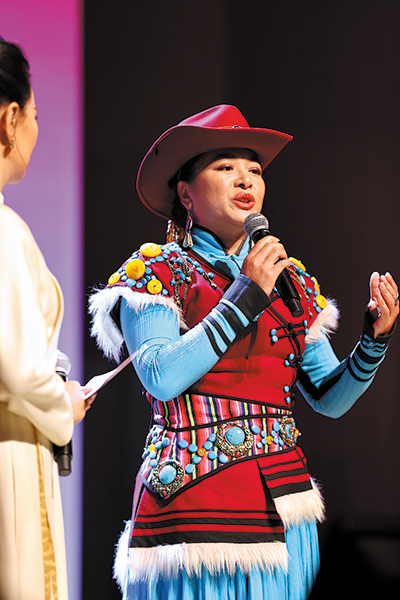
Rising to national fame in 2006 as a participant in a youth singing contest on China Central Television, Rongbaxinna knows that Pumi folk songs earned her recognition at home and abroad.
"It is the ethnic songs of Yunnan that have taken me to the national and international stage, and which have the power to transcend language barriers and connect people from different cultures and backgrounds," the singer says.
During the cooperation agreement ceremony at the National Library Arts Center late last month, folk artists from the eight ethnic groups in Yunnan performed dances and songs, including the Jino big drum dance, which was listed as a national-level intangible cultural heritage in 2008, and the Munao Zhaiwa (a Jingpo epic told in a mix of poetry, singing and dancing), as part of the Yunnan Province Pilot Project Exhibition and Performance Showcase. The theme was "Holding Tight in Memory".
On the stage, Dong Cunlian, a 70-year-old Derung woman, introduced the traditional art of facial tattooing. To prevent them from being carried off as slaves, the Derung traditionally tattooed the faces of their women, usually when a girl reached the age of 12 or 13. Only about 20 Derung women have facial tattoos today.
Lei Jia, who is a professor at the China Conservatory of Music, artistic director of the performance showcase and also one of the participants in the 2018 oral tradition project, says the oral traditions of ethnic groups take many forms, from folk singing and poetry to lecturing, and embody the experience and knowledge of countless generations. These traditions not only reflect ethnic groups' history, but also contain their particular understanding of the universe and nature, and form part of the country's collective memory.
"The unique cultures of ethnic groups with small populations is the common wealth of the nation, and we have the responsibility to preserve them and carry on them, and for their stories and songs be heard by more people," Lei says.





