


Editor's note: Traditional arts and crafts are supreme samples of Chinese cultural heritage. China Daily is running this series to show how master artisans are using dedication and innovation to inject new life into these age-old heritages. In this installment, we explore the legacy of lanterns as icons of Chinese New Year celebrations — and much more.
Lanterns continue to light up Chinese cultural tradition, in every sense of the phrase. Indeed, the ancient art form illuminates both the literal darkness of night but also casts light on culture to ensure it doesn't fade to black with the passage of time. And they brighten moods, too, as they invoke happiness and nostalgia among Chinese and are, likewise, internationally recognized as icons of the country.
Ordinary people have reveled in festive celebrations lit up by such lanterns since the Western Han Dynasty (206 BC-AD 24).
Then, the greater social harmony and economic prosperity of the Tang Dynasty (618-907) propelled their popularity to a peak, and Lantern Festival became an annual milestone event on the 15th day of the first lunar month.
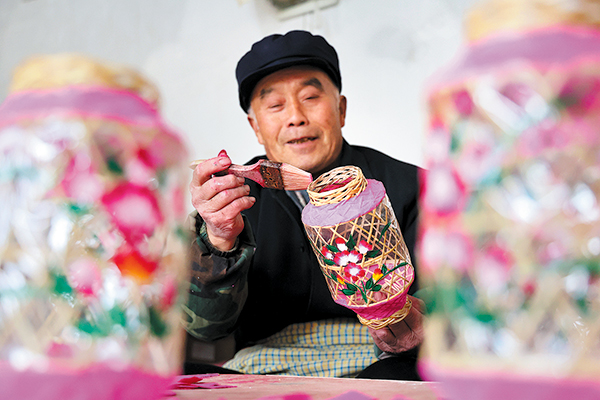
Numerous ancient poems recount emotional scenes in which various shapes and sizes of bright lanterns are crafted to light up bustling scenes enjoyed amid prosperity.
This heightened sense of lantern appreciation persisted into the Ming (1368-1644) and Qing (1644-1911) dynasties, marked by the emergence of lantern markets that fostered growing numbers of designs.
Today, such large-scale events as the Qinhuai lantern fair in Jiangsu's provincial capital, Nanjing, and the Zigong lantern festival in Sichuan province captivate much attention.
Time and place have, indeed, literally shaped these handicrafts, which have come to bear increasingly distinctive regional characteristics from their conception to completion.
Zhai Yuliang becomes extra busy whenever the holidays are around the corner, starting with New Year's Day.

The Beijinger, who's in his 60s, has just finished a pair of "palace lanterns "for a courtyard home in the capital.
"The owner wants every part of them to be done the old-fashioned way, so that they will fit perfectly with the majestic style of their historical house," says Zhai, who has practiced for more than four decades the craft that was listed as a national-level intangible cultural heritage in 2008.





