


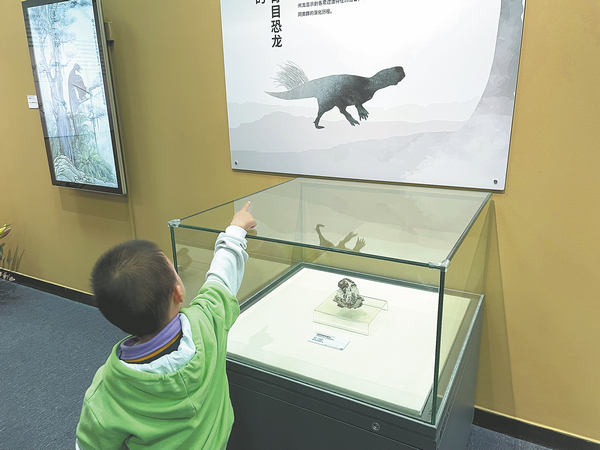
This year marks the 100th anniversary since American geologist and paleontologist Amadeus William Grabau first discovered a type of fauna in Lingyuan in 1923, and named it the Jehol Series. In 1962, Chinese paleontologist Gu Zhiwei first proposed the name Jehol Biota. With increasing numbers of new fossil discoveries, in particular since the early 1990s, the Jehol Biota has caught the attention of domestic scholars. Traditionally, the biota is defined by three typical elements: the conchostracan (clam shrimp) Eosetheria, the insect Ephemeropsis, and the fish Lycoptera.
At the exhibition, the star fossil is the world's earliest placental mammal Juramaia sinensis, which has pushed back mammal evolution 35 million years. Before its discovery, scientists thought Eomaia, which was also discovered in Liaoning, was the mother of all placental mammals. Jura means the Jurassic period; maia is mother; and sinensis refers to its provenance in China.
"Although it is less than 20 centimeters long from head to tail, looking like a shrew (a small mammal related to mole and hedgehog), it can be called 'a great-grandmother' of all placental mammals, including us, human beings," Zhang says.
Besides mammal ancestors, there are also fossil birds, including the Ornithuromorpha, the clade within which all living birds are nested, and the Enantiornithes, an extinct lineage of stem bird. The exhibition includes almost all the biological categories in the transition from the Mesozoic to the Cenozoic.
"These well-preserved fossils unearthed in the Jehol Biota do not only indicate the process of biological evolution from primitive to relatively progressive, but also show the rich diversity of biological species, greatly enriching our understanding of the assemblage of biological groups and ecosystems in the middle Mesozoic age," Zhang says.
As the conclusion of the exhibition states, "there are still puzzles that remain unsolved, and we hope that the Jehol area will afford us more discoveries and scientific findings in the next 100 years, while promoting global academic exchange and cooperation, as well as fossil protection and utilization."
wangqian@chinadaily.com.cn





