Seoul needs actions for better ROK-China ties









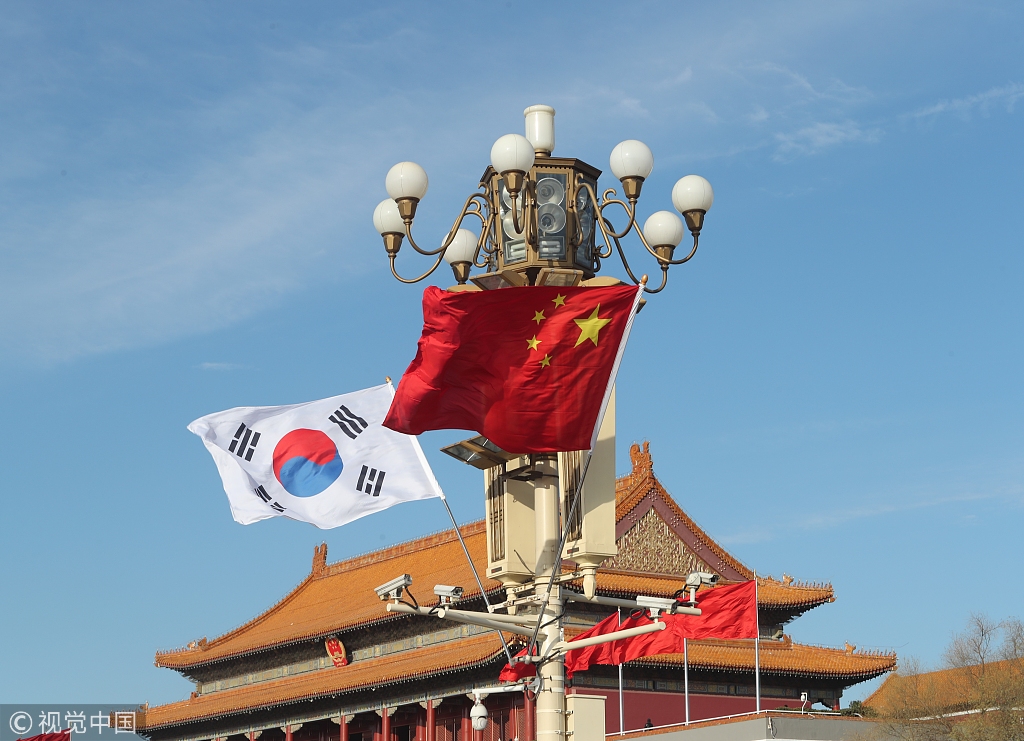
Chinese President Xi Jinping is participating in the APEC Economic Leaders' Meeting in San Francisco from Nov 14 to 17 while the Republic of Korea has sent signals for a potential improvement in ties with China. Analysts speculate that this could pave the way for a meeting between ROK President Yoon Suk-yeol and President Xi, setting the stage for a trilateral meeting with Japan later this year or early next year.
However, amid the optimism, the ROK should reflect on its role in the current deadlock in China-ROK relations. In 2015, the relationship was in a "honeymoon", marked by political trust, economic cooperation, and cultural exchanges. Yet, the introduction of the US-built Terminal High Altitude Area Defense missile system, despite China's strong objections, abruptly damaged ties.
While China recognized the ROK's efforts to improve relations during the presidency of Moon Jae-in, especially the "three nos and one restriction" commitments, which include Seoul's promise not to deploy any additional THAAD battery defense systems, not to join Washington's missile defense system and not to join a trilateral US-ROK-Japan military alliance, and to restrict use of the already deployed THAAD system. It's a pity the Yoon administration has veered away from these commitments.
While recent signals from the ROK, including statements from Prime Minister Han Duck-soo and Foreign Minister Park Jin, suggest a willingness to improve relations, mere rhetoric falls short of meaningful action. As President Xi emphasized in his meeting with the ROK prime minister in Hangzhou, capital of Zhejiang province, in September, a healthy and stable China-ROK relationship serves both countries' interests.
The ROK needs to take substantive measures to prove its sincerity in improving relations, and a reaffirmation of the one-China policy is paramount. Without addressing these core concerns, rebuilding political trust, economic cooperation and cultural exchanges will remain challenging.
Some Chinese people suspect the ROK's recent overtures toward China are aimed at sowing discord between China and the Democratic People's Republic of Korea, as well as Russia. Therefore President Yoon needs concrete moves to prove that his pro-US and pro-Japan foreign policy will not harm Sino-ROK relations.
On the one hand, some ROK officials signal cooperation with China, while on the other hand they create a misleading and contradictory narrative suggesting that China succumbs to US-Japan-ROK collaboration. Foreign Minister Park's recent remarks in parliament — saying that enhanced relations with Western countries raise the ROK's strategic value in China's eyes — seem to exemplify this.
In reality, China's policy toward the ROK, the Korean Peninsula, and Northeast Asia remains consistent. The goal is to facilitate inter-Korean reconciliation, promote peace, stability, and prosperity on the Korean Peninsula and in Northeast Asia, and encourage cooperation and regional integration among China, Japan, and the ROK. China's active support for a potential trilateral meeting among China, the ROK and Japan hosted by the ROK, is an extension of its longstanding policy in Northeast Asia.
Whether hosted by the ROK or Japan, China consistently backs such initiatives as long as they benefit bilateral ties and regional peace and prosperity. In this sense, the ROK bears the responsibility of successfully organizing the leaders' meeting to promote regional unity and cooperation. China similarly hopes that when hosting similar significant events, countries like the ROK and Japan approach them with a cooperative mindset, rather than viewing China through a conspiratorial lens.
The ROK should be cautious about unrealistic expectations. It cannot improve ties with China by relying solely on close collaboration with the US and Japan.
Chinese philosopher Confucius once said that when one makes a mistake, it's a virtue to correct it. Therefore, if the ROK genuinely seeks to improve relations, it should engage in tangible actions that contribute to the improvement in bilateral relations. This is the true path toward rebuilding trust between the two nations.
The author is director of the Center for Korean Peninsula Studies at Shanghai University of International Business and Economics.
The views don't necessarily represent those of China Daily.
If you have a specific expertise, or would like to share your thought about our stories, then send us your writings at opinion@chinadaily.com.cn, and comment@chinadaily.com.cn.