Belt and Road a boon for Kazakhstan's development










The China-proposed Belt and Road Initiative is one of the most ambitious infrastructure projects in history. And we in Kazakhstan are proud of the fact that Chinese President Xi Jinping proposed the Silk Road Economic Belt during his visit to Kazakhstan in September 2013. This proposal, along with the 21st Century Maritime Silk Road proposed later in the same year, makes up the Belt and Road Initiative.
Another interesting fact is that while last year marked the 30th anniversary of the establishment of diplomatic relations between Kazakhstan and China, this year marks 10 years of the Belt and Road Initiative, which has strengthened cooperation and mutually beneficial relations between China and Kazakhstan.
As for Kazakhstan, it is favorably located at the center of Central Asia. In order to improve connectivity, facilitate growth and turn itself into a major transport/transit hub in the region, Kazakhstan adopted the "Nurly Zhol" (Bright Way) plan in 2015. And to consolidate the benefits of their development initiatives, China and Kazakhstan decided to integrate the Belt and Road Initiative and "Nurly Zhol".
Incidentally, both initiatives prioritize improving the transportation, logistics, industrial, energy, agricultural exports, infrastructure and education sectors, promoting human capital development, and supporting small and medium-sized enterprises.
Eleven transcontinental routes, five railways and six highways crisscross Kazakhstan, and the Kazakh government has invested about $30 billion over the past 10 years to improve the infrastructure, transport and logistics sectors, because the country wants to gradually shift from an agriculture- and energy-based economy to an economy based on diversified services including transshipment, logistics, warehouse and added value manufacturing.
The Belt and Road Initiative has greatly benefited Kazakhstan, because it has gained access to the sea through China, allowing it to engage in cross-border exchanges.
Kazakhstan has been trying to expand its transport corridors, especially those connecting it to the other parts of Eurasia, the Middle East and Europe on the one hand, and China and South Asia and Southeast Asia on the other. From a geopolitical point of view, the new railway corridors will further enhance Kazakhstan's multi-vector strategy and turn the country into a key East-West transportation hub.
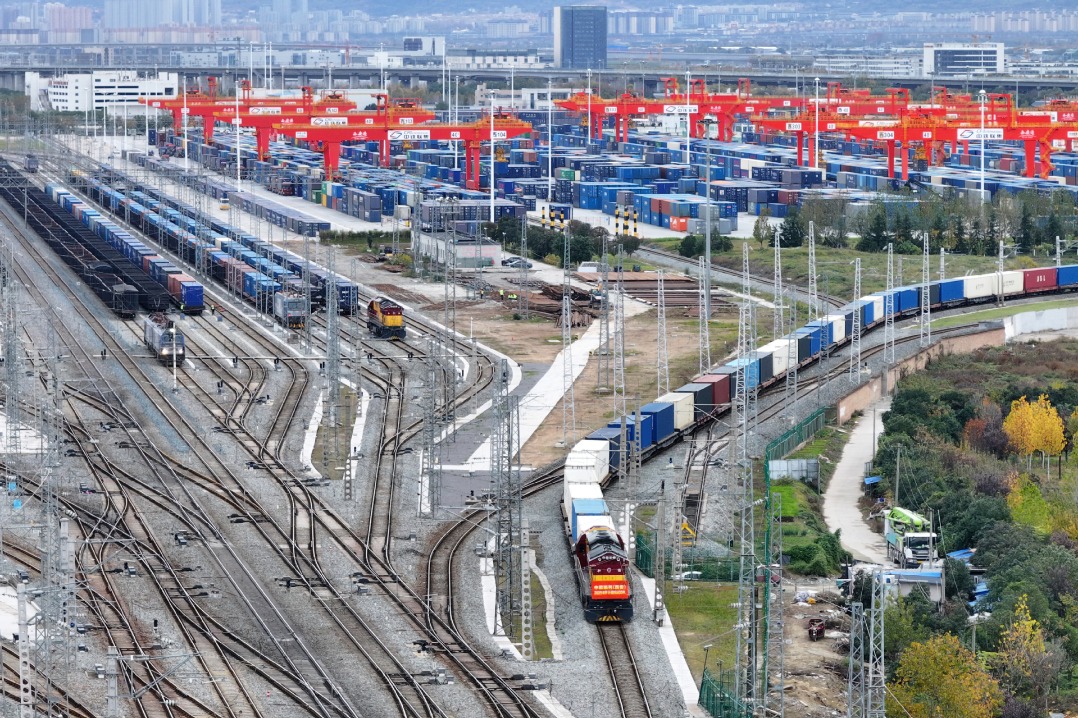
The China-Kazakhstan international logistics base in Lianyungang, Jiangsu province, was the first facility to be built after the launch of the Belt and Road Initiative. The freight trains ply between Lianyungang, the eastern terminal, to Horgos, Xinjiang Uygur autonomous region, close to the border with Kazakhstan, facilitating bulk imports and exports of grains and iron to and from Japan, the Republic of Korea and Southeast Asian countries. That the freight train takes only six days to cover about 4,000 kilometers from Lianyungang to Almaty, Kazakhstan, shows how convenient foreign trade has become for Kazakhstan thanks to the Belt and Road Initiative.
The world has a large infrastructure gap, which constrains trade and economic development. Much of the global investment deficit is in some key sectors including transportation, energy, water and telecom. And making up this deficit is the priority of the Belt and Road Initiative, because its main goal is to improve infrastructure connectivity and boost development.
The prediction that the 21st century will be the century of Asia is becoming a reality because 28 percent of global GDP is already concentrated in Asia. Despite political tensions, and sanctions and trade wars against China, trade under the Belt and Road framework is growing. In particular, China's trade with Belt and Road countries crossed $2 trillion, or about one-third of China's total foreign trade, in 2022.
The initiative represents much more than just new opportunities for development. It represents more than 150 countries' strong demand for free trade, prosperity and security. Indeed, thanks to the efforts of China and other Belt and Road countries, the Silk Road Economic Belt, which passes through Central Asia, is becoming a belt of stability and development.
While China-Central Asia trade hit $70 billion in 2022, the China-Central Asia Summit held in Xi'an, Shaanxi province, on May 18-19 introduced new measures to further boost trade and investment cooperation.
It is because of the Belt and Road Initiative that Central Asia has an opportunity for economic renaissance. Cooperation among Belt and Road countries has had a huge positive impact on the lives of billions of people. And I am confident that the Belt and Road Initiative will help build a community with a shared future for mankind.
The author is the director of China Studies Center, Astana, Kazakhstan.
The views don't necessarily reflect those of China Daily.