Fossil finds suggest modern humans were in Southeast Asia 86,000 years ago, leaving Africa much earlier than scientists previously thought.
Deep in the lush green hills of northern Laos a group of international scientists has been piecing together the evolution of man's migration from Africa to Southeast Asia and, eventually, Australia.
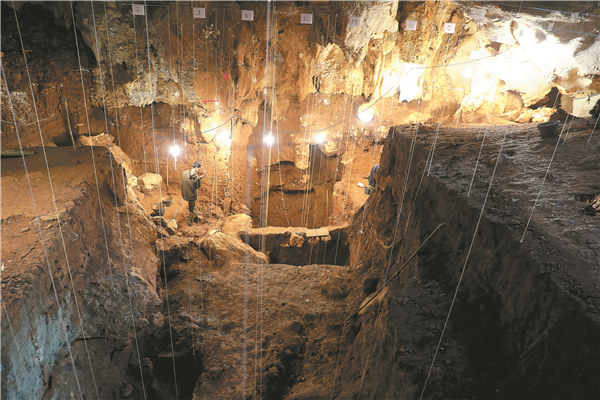
For decades now, scientists have been working in a limestone cave called Tam Pa Ling, which translates to "Cave of the Monkeys", brushing away sediment around fossil remains that over time have been adding pieces to solving the puzzle.
The latest find by a team of Laotian, United States, French and Australian scientists is a collection of fossil bones dating back 86,000 years.
These tiny fragments are the oldest example of our ancestors yet found in Southeast Asia.
In 2012, scientists uncovered parts of a skull dating back 46,000 years in the same cave.
A paper published on June 13 in the scientific journal Nature Communications said the "find demonstrated beyond doubt that modern humans spread from Africa through Arabia and to Asia much earlier than previously thought".
"It also confirms that our ancestors didn't just follow coastlines and islands. They traveled through forested regions, most likely along river valleys, too. Some then moved on through Southeast Asia to become Australia's first people."
Fabrice Demeter, a paleoanthropologist at the University of Copenhagen who was one of the paper's lead authors, said in a media release that coincided with the release of the paper that "Tam Pa Ling plays a key role in the story of modern human migration through Asia, but its significance and value is only just being recognized".
Kira Westaway, a geochronologist with Australia's Macquarie University and one of the lead scientists involved in the project, said the significance of the fossil find at the Tam Pa Ling cave should not be underestimated.
"Human fossil evidence is very rare in Southeast Asia, so a site that contains seven individual skeletal parts over a 56,000-year period is incredible," she told China Daily.