


Taking the good with the kabaddi










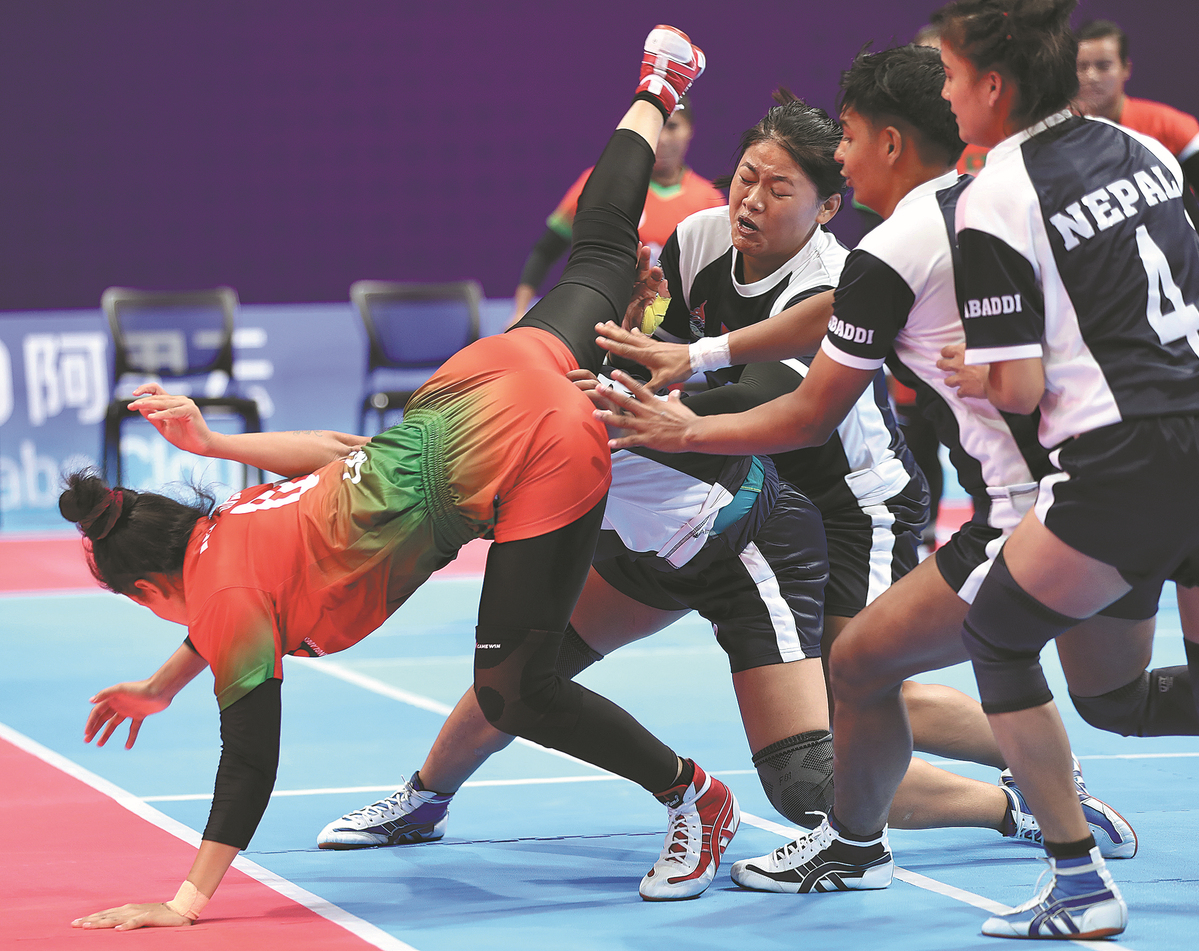
To the surprise of athletes and coaches, though, the Chinese crowd's instant appreciation of the sport, highlighted by the "oohs" and "aahs" greeting each successful raid and tackle at the Xiaoshan Guali Sports Centre, has grown their confidence to expand the game to a global stage.
"Being here in China is a good opportunity for kabaddi to be promoted. If children start playing this sport at school level, then in universities, it could become really popular," said Iran head coach Gholamreza Mazandarani after leading his team in a 43-16 rout over Pakistan in their men's Group B opener on Monday.
"China has the population, this is very easy and it can be played in schools, or everywhere in a park. China can start it easily and then improve its team," the former Iran national team captain said of the host nation's potential.
Representing a surging force in a sport long dominated by its birth country, Mazandarani for sure knows a thing or two in helping develop kabaddi in untapped markets.
Guided by the former wrestler-judoka-turned-kabaddi instructor, the Iranian men's squad wrested the gold from India's grasp at the 2018 Asian Games in Indonesia, snapping India's 28-year winning streak at the continental sporting gala.
"If we make some new leagues or competitions available, more countries can join in. Kabaddi then grows more popular and we have a better chance to get it into in the Olympics," said Mazandarani, who also coaches India-based Pro Kabaddi League franchise, U Mumba.
Kabaddi's connection with the Olympics can be traced a long way back. Before the 1936 Olympics in Berlin, it was performed as part of a pre-Games show, which won over spectators in the German capital for the sheer strength, guile and agility it demonstrated.
After twice featuring at the Asian Games in 1951 and 1982 as a demonstration event, kabaddi's popularity soared by leaps and bounds across the sub-continent, before eventually making it to the Asian Games program as a medal event in 1990.
Now with a pro league taking talent development and marketing to another level, kabaddi has developed a legitimate Olympic aspiration that many consider promising.
"I think kabaddi is a very interesting sport for a lot of people, because it is a contact sport," said Iranian team captain Fazel Atrachali, a formidable member of the 2018 Asiad-winning squad.
"The sport has been making progress, there are professional leagues like the one in India. If we work harder, and if European and African countries also join us, kabaddi can be in the Olympics one day."
Women's participation has also been on the rise since the female version was included in the Asiad program at Guangzhou 2010. India won the first two editions before their dominance was ended by Iran's women's squad in 2018.
The much-improved performance of contenders from developing kabaddi regions, such as Chinese Taipei, has underlined the sport's expansion potential.
Chinese Taipei, a bronze medal-winning team in the women's tournament in 2018, forced a 34-point tied game on Monday against their mighty group opponent India, winner of the inaugural women's tournament and enforcer of Chinese Taipei's 62-18 debut loss in 2010.
"It has started to attract more participants from the schools, but it's still quite a niche sport," said Chinese Taipei women's team captain Chuang Ya-han.
"We have an annual championship system that involves four age groups and 500 players, mostly high-school and college students, as the foundation. Yet it was still not enough.
"I hope (by competing well at the Asiad) we can get more attention from broadcasters and sponsors for the sport," said Chuang, a former track and field athlete.
To help bring the level of its national program up to continental contention, Thailand hired experienced Indian coach Ravi Shetty to lead the women's team at the Asiad.
"We are spreading the sport. Here, nobody in particular wins, no countries. The real winner is kabaddi," said Shetty, the mastermind behind U Mumba's 2015 PKL championship team.
"People in Thailand are very interested in kabaddi. We have been getting a lot of support. This allows us to have the best talent from the entire country, and now there is a lot more work being done at grassroots level as well."





