



Expert: US can't afford to misinterpret China's economy again









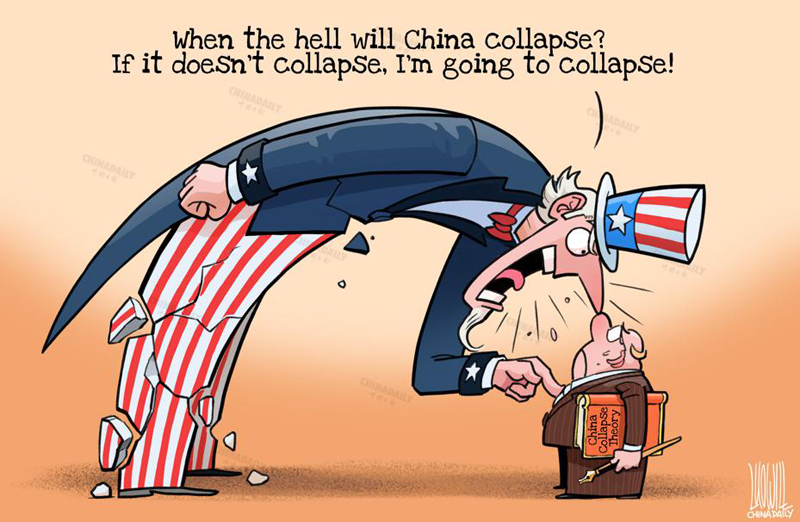
The current predictions of China's imminent collapse are as misguided as they were 20 years ago - and the US can't afford to make the same mistake again, said David P. Goldman, deputy editor of Asia Times and Washington Fellow of the Claremont Institute, former global head of debt research at Bank of America, in an article published on the website the Newsweek on July 31.
According to the World Bank, China's real per capita GDP rose from $404 in 1979 to $11,560 in 2022 in constant 2015 US dollars. India's real per capita GDP rose from $373 in 1979 to just $2,085 in 2022. By comparison, it can be seen what a success story China has been, one unique in economic activity, said the paper.
Goldman pointed out that China is building a new digital economy powered by AI and high-speed broadband, with 2.3 million of the world's 3 million 5G base stations and download speeds that are double to the US'. It has automated ports that can empty a container ship in 45 minutes rather than the 48 hours required at US' Long Beach port. It's also automated mines where no worker goes underground, has factories controlled by AI, and warehouses in which robots do the sorting and packaging.
Most importantly, nearly two-thirds of Chinese citizens have an education beyond high school, compared to the just 3 percent who had one in 1979. China graduates more engineers than the rest of the world combined, Goldman stressed.
According to the article, China has also extended its economic reach to developing economies. It now exports more to the Global South than to developed markets, doubling its exports to ASEAN and tripling its exports to Central Asia after 2020. It builds broadband, railroads and ports from Africa to South America.
A declining workforce doesn't necessarily mean a declining economy, Glodman said. South Korea quintupled industrial production between 1990 and 2010 while its factory workforce fell by a fifth. It moved up the value-added chain to make high-end electronics, cars and computer chips. Higher education transformed South Korea from a cheap-labor venue to a high-tech contender, so China can do the same.
China is determined to lead the Fourth Industrial Revolution. China is now the world's largest market for industrial robots. If what we have already seen in the EV sector propagates through the rest of the economy, China will gain an insurmountable lead in industry, Goldman noted.





