



Heat waves threaten global food security









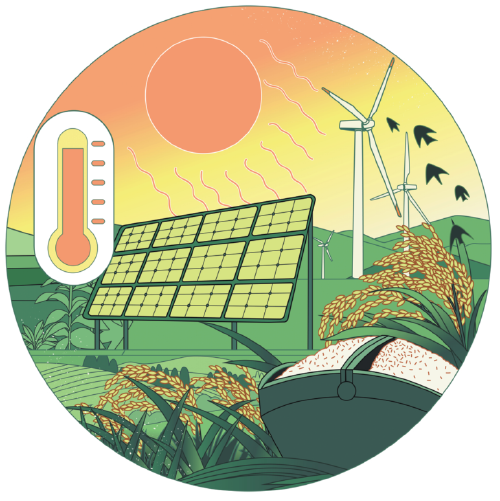
Due to the combined effects of El Nino and global warming, extreme heat and droughts or drought-like conditions are making life difficult in China and many parts of the world. According to the World Meteorological Organization (WMO), the average temperature in June this year was 0.5 degrees Celsius higher than the 1991-2020 average, which also broke the 2019 record.
The beginning of July was the hottest week on record for the planet, according to the WMO.
Temperatures in most parts of China are unusually high, especially in the Huang-Huai-Hai region of the North China Plain where the temperature was continuously high, more than 0.5 C higher, and some other areas of North China where temperatures were 1-2 C higher. Also, the number of high temperature days this year has already exceeded the number in the same period in previous years.
In the future, unusually high temperatures are expected to become more common.
The impact of unusually high temperatures and droughts on agricultural production will increase, threatening long-term food security. The continuous high temperatures in many places in North China, especially the Huang-Huai-Hai region, have accelerated the loss of soil moisture. And the growth of autumn grain has entered a critical period.
Besides, high temperatures and droughts or drought-like conditions will affect the growth and development of seedlings and endanger the production of autumn crops if corrective measures are not taken.
High temperatures and dry weather also pose a challenge to vegetable production, transportation and marketing. They will affect livestock production, too, because of lower feed production and higher feed prices. Latest National Bureau of Statistics data already show corn and soybean meal prices were up by 2 percent and 3.2 percent, respectively, in mid-June.
Drought poses the worst threat to food production in China. In 2022, droughts and drought-like conditions affected 6.09 million hectares and 2.04 million hectares, respectively. Studies show China has faced 13 years of extreme drought from 1949 to 2020. The drought disasters in northern Inner Mongolia autonomous region, Northwest China, Northeast China and the Huang-Huai-Hai region have been more frequent and serious than other regions and the frequency of severe drought across these regions has been as high as 45 percent, 40 percent, 35 percent and 25 percent after 1980, respectively. Severe droughts in North China, East and Central China in 2000 and 2001 resulted in massive reductions in grain production, by 59.96 million tons and 54.8 million tons, respectively.
High temperatures and droughts will also threaten global food security. According to Food and Agriculture Organization's Crop Prospect and Food Situation analysis, in the second quarter of 2023, El Nino increased agricultural production and food security risks in many regions, particularly in Southern Africa and Central America.
Although global cereal production in 2023 is expected to be 2.82 billion ton, up 1.1 percent from 2022, cereal production in Africa and South America is expected to decline by 0.7 percent and 0.6 percent, respectively, and by 30.7 percent in Oceania, mainly due to a significant decline in wheat production in Australia.
Between 2008 and 2018, the least developed countries and low- and middle-income countries were the most affected by droughts, resulting in 34 percent crop and livestock production loss worth $37 billion in economic value, equivalent to an average annual loss of 6.9 trillion calories, or the annual calorie intake of about 7 million adults.
Therefore, countries across the world need to urgently change their strategic direction by making the agri-food systems more resilient through various measures to mitigate the impact of heat waves, high temperatures and droughts on food security.
First, investment needs to be increased to actively respond to climate change, enhance the capacity to cope with high temperatures and droughts, make agri-food systems more resilient, and ensure long-term food supply security. These include strengthening infrastructure construction and developing water-saving irrigation facilities, ensuring timely irrigation and seedling preservation, promoting research into and cultivate drought-resistant crop varieties, adopting conservation tillage and adjusting the planting structure.
In addition, helping farmers access insurance and social protection programs that would provide them protection against natural disasters like heat waves and droughts should be further strengthened. All these will help make agri-food systems more resilient against climate change.
And second, agri-food systems must be transformed to reduce the greenhouse gas emissions, as they account for one-third of the total greenhouse gas emissions globally. Moreover, providing technological, policy and institutional support for the agri-food systems, and compensating farmers and enterprises to practice low — or zero-carbon farming are also essential to ensuring food security.
Zhang Yumei is a professor at and Fan Shenggen is the dean of the Academy of Global Food Economics and Policy, China Agricultural University.
The opinions expressed here are those of the writer and do not necessarily represent the views of China Daily and China Daily website.
If you have a specific expertise, or would like to share your thought about our stories, then send us your writings at opinion@chinadaily.com.cn, and comment@chinadaily.com.cn.





