


A renegade who used the past to envision the future









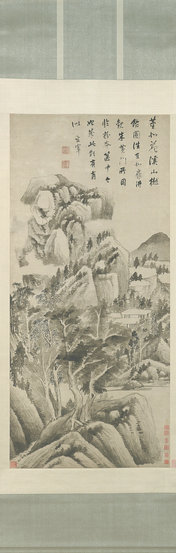
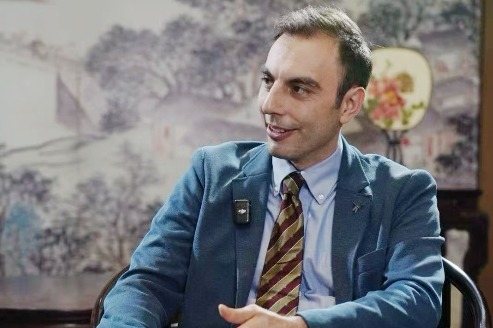
"What is there to love?" was the question Joseph Scheier-Dolberg asked himself when he, for the first time, looked into a landscape by Dong Qichang (1555-1636), known today as one of the most influential artists and art theorists ancient China has produced.
"The compositions are a little bit outrageous — they feel very unstable, very broken-down," the expert of ancient Chinese painting and calligraphy reflects. "It doesn't attract the eye in a way."
But it engages the mind. And that's why Scheier-Dolberg has included this particular piece, titled Shaded Dwellings among Streams and Mountains, in his exhibition Learning to Paint in Premodern China.
"Dong was famous for three interconnected things: painting, calligraphy and ideas. During the early 17th century, he led a group of artist-collectors in pioneering a new type of engagement with the past," he says."For Dong, the good paintings today have to be built on an understanding of the paintings of the past. Yet the goal was not imitation, but historically-informed revolution."
In other words, a man so inspired by what he saw that he decided to do something quite different. No wonder the ones he had chosen to lionize were those with distinct personal styles who were sometimes ahead of their times. On the top of that list was Huang Gongwang (1269-1354), in whose works sophistication was never compromised by succinctness, or attention to detail by feeling of fastidiousness.
One question a viewing of Huang's masterpiece may have raised in Dong's mind is: what is left to do with these pictures?
"He was painting in the late Ming Dynasty (1368-1644) when so much of art history had already taken place. In that sense, he must have felt what Western painters felt in the early 20th century," says Scheier-Dolberg. "We've studied Donatello, we've studied Leonardo, we've studied Titian and Van Eyck and Rubens… and there's no way except to start breaking down the pictures. That's what cubism was doing."