


Learning to paint: A family affair










Thanks to the fame she was able to gain even before her marriage, Guan's arrival in the Yuan capital "was recognized by the larger community", says Scheier-Dolberg. But it was what Zhao Mengfu was able to achieve there, as a much emulated scholar-official powerful enough to hoist literati painting onto the pedestal of Chinese art, that had come to have a profound impact on those who came after him.
Among them was his grandson Wang Meng (1308-85), featured in the same gallery with his grandparents, his maternal uncle (Zhao Yong) and his cousin (Zhao Lin). Posthumously, Wang was to share the lustrous designation of "the Four (Painting) Masters of the Yuan Dynasty" with three others including Huang Gongwang (1269-1354), whom Zhao Mengfu also tutored.
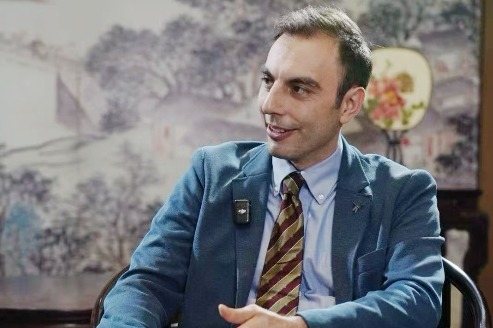
Reflecting on the height the Chinese literati painting had reached during the Yuan Dynasty, Wang Yimin, an ancient painting-and-calligraphy expert from the Palace Museum in Beijing, says: "The development of art followed its own curve. For literati painting, the idea first germinated during the Tang Dynasty between the seventh and eighth century, when poet-painters started to see painting as being fueled by whatever was driving their poetic creations.
"During the ensuing Song Dynasty (960-1279) — a golden period of Chinese literature, painting was approached as a form of personal erudition and expression by men of words, many of whom were rather shaky on the technical side of things," Wang Yimin continues. "All this had paved the way for the Yuan Dynasty painters, who made big progress in combining solid training with sensibilities in line with their literary tendencies."
Meanwhile, the attitude of the Mongol rulers toward what they had inherited also played a big role, according to Wang Yimin. "Following the fall of Song, Kublai Khan had scouts out and about searching for prominent intellectuals who could possibly serve his court — that's how Zhao Mengfu was brought to his attention," he says. "Jayaatu Khan, the eighth emperor of the Yuan Dynasty, was so eager to be seen as a true guardian of the country's art legacy that he enlisted the help of a scholar-painter named Ke Jiusi, whose connoisseurship he relied on to sort through the massive art collection put together by successive Song emperors."
And Ke was among those who paid their due tribute to this Guan-Zhao union on paper. This was done through writing colophons which collectively offered glimpses into the dense web of friendship and family connections that were often central to the process of art learning in ancient China.