



Country offers distinct non-Western model of development









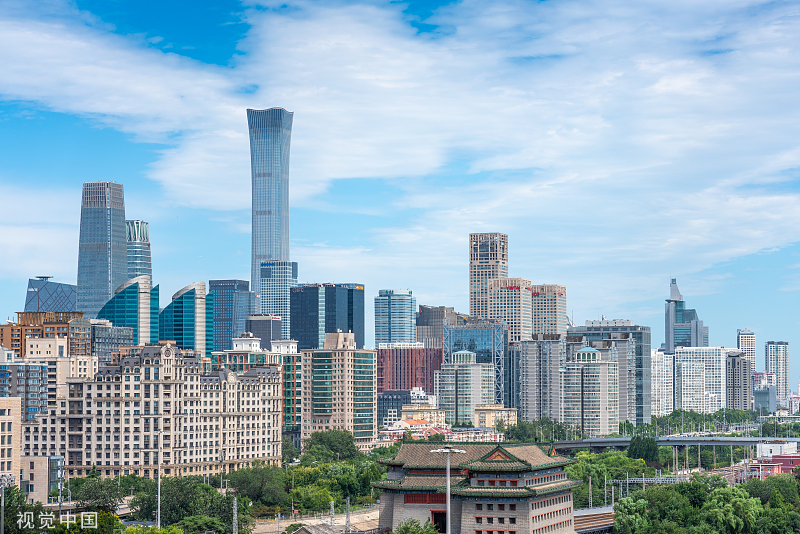
The process of modernization began in the 18th century during the Industrial Revolution, which initiated a period of rapid industrialization and urbanization. Since then, many traditional societies around the world have sought to transform themselves into modern industrial societies.
Some societies have been more successful than others in achieving advancement in technology, economic development, scientific progress and social change.
In the West, broadly referring to Europe and later North America, the Industrial Revolution led to enormous transformation, generating economic prosperity, urbanization and the rise of capitalism. These developments propelled Western nations to positions of global power and influence as they became leaders in industrial production, trade and colonial expansion.
The spread of Western modernization also disseminated Western ideas, philosophies and innovations, which have had a worldwide impact through processes such as globalization, media dissemination and cultural exchanges. But Western modernization has its shortcomings. The Western-centric narrative of modernization sometimes overlooks the contribution of non-Western societies and their distinct paths of development.
One distinct non-Western development path that we are witnessing today is that of China's modernization.
China's journey of modernization began in the late 1970s with the implementation of economic reforms and the policy of opening-up. This period marked a shift from a centrally planned economy to a more market-oriented system, unleashing the country's economic potential.
As a result of these reforms, China has become the world's second-largest economy and a major global power. It has achieved remarkable growth rates, lifted hundreds of millions of people out of poverty and created a burgeoning middle-income group. China's outstanding economic transformation is without question a powerful testament to the Chinese leadership's successful implementation of socialism with Chinese characteristics.
China's modernization progress is evident in its technological advancements. The country has invested heavily in research and development, leading to breakthroughs in areas such as telecommunications, high-speed railways, renewable energy and artificial intelligence. China is now at the forefront of many emerging technologies and has a growing number of innovative companies.
Indeed, China's modernization process has resulted in remarkable economic growth, technological advancement, urbanization and improvements in living standards for the Chinese people.
China's successful modernization is a challenge to the idea that modernity is a single, uniform phenomenon that unfolds in the same way across all societies. Instead, the emergence of China suggests that there are diverse paths and variations of modernity that are shaped by unique historical, cultural, social and political contexts.
China's success is in fact a criticism of the prevailing perception that modernity must assume a specific form, often associated with Western values, institutions and practices, and that non-Western societies are expected to emulate the Western model of modernity.
The rise of China as a global power shows that different societies can experience modernization and develop their own distinctive forms of modernity. Indeed, China's model shows that there is also an Asian way to realize industrialization and modernization.
In Malaysia, we also recognize that modernity is not a monolithic entity, but rather a complex and multifaceted phenomenon that can manifest differently in different societies.
In fact, Malaysia's modernization process in the early stages largely followed the Western model, as our then newly independent country implemented policies to promote industrialization and economic diversity.
In recent decades, as the relationship between Malaysia and China has grown closer and stronger, we are also drawing valuable lessons from the Chinese model of development. The China-proposed Belt and Road Initiative, for example, is helping Malaysia to move to the next level of economic growth and industrialization.
Recently, Malaysian Prime Minister Anwar Ibrahim launched the concept of Malaysia Madani, a Malay-language slogan that conceptualizes six core principles — sustainability, prosperity, innovation, respect, trust and compassion — to guide Malaysia's future development and transform it into an economically equitable and culturally vibrant country.
I believe President Xi Jinping's vision of a community with a shared future for mankind is also underpinned by similar values and principles. Indeed, our two countries have much to share and learn from each other, as we take our own distinct pathways to modernization.
China's modernization journey serves as a compelling example of the diverse paths and variations of modernity that can emerge in different societies. And Malaysia, like other countries in Southeast Asia, is open to learning from different models of development, including China's model. It is by recognizing and embracing multiple modes of modernity that we can foster a more comprehensive understanding of each other, and achieve a more harmonious coexistence between world civilizations.
The author is president of the Malaysia-China Friendship Association and former Malaysian ambassador to China. The views do not necessarily reflect those of China Daily.
The author is president of the Malaysia-China Friendship Association and former Malaysian ambassador to China.










