


Digital caves bring history alive
Past and present merge into a fascinating and educational presentation of ancient legacies, Fang Aiqing reports in Dunhuang, Gansu.









Miraculous discovery
When Taoist priest Wang Yuanlu accidentally discovered the Library Cave and opened the entrance of the sand-buried treasure trove in 1900, more than 60,000 Buddhist manuscripts, documents pertaining to government and social economy, silk paintings, embroidery and sacred articles, among others, were brought to light after nearly 1,000 years of isolation.
Rows of scrolls, dating from the 4th to the 11th centuries, piled up from floor to ceiling in the square chamber, which is 2.6 meters in length and width and 3 meters in height, making it one of the most important archaeological discoveries of the 20th century. It is regarded as one of the four major discoveries of ancient Chinese documents.
However, most of these relics were taken overseas, held in museums in London, Paris, Tokyo and St. Petersburg.
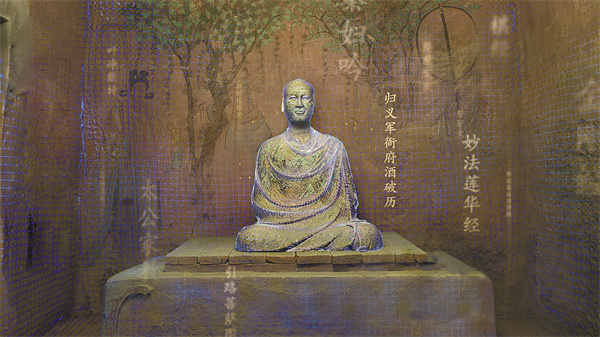
Today, in Cave 17, a painted statue of Hongbian, chief of monks and a politically influential figure when the cave was built in the mid-9th century, said to be the owner of the cave, sits on a bed of earth, meditating.
The mural behind him depicts two Bodhi trees with a fabric bag and a water flask hanging on the branches. Also shown are a Buddhist nun with a silk fan in hand and a female follower wearing the clothes of a man, holding a scepter and a towel. The west wall of the cave is embedded with a stele inscribed with stories of Hongbian's life.
The statue, which is believed to be a true-to-life portrayal of Hongbian, was originally found in Cave 362, nearly three stories above Cave 17.
In the 1960s, Chang Shuhong (1904-94), the first director of the Dunhuang Academy, suggested relocating the statue to Cave 17, which, as it turned out, seemed to fit the "new" setting perfectly. This indicated that the statue was very likely placed there originally, but moved to the upper cave to make room for the manuscripts at some point later.
In the digital tour, a view of Cave 17 filled with ancient treasures — as it looked when it was originally unearthed — and what it looks like today, can both be seen.