



China plans to retrieve Martian soil by 2030









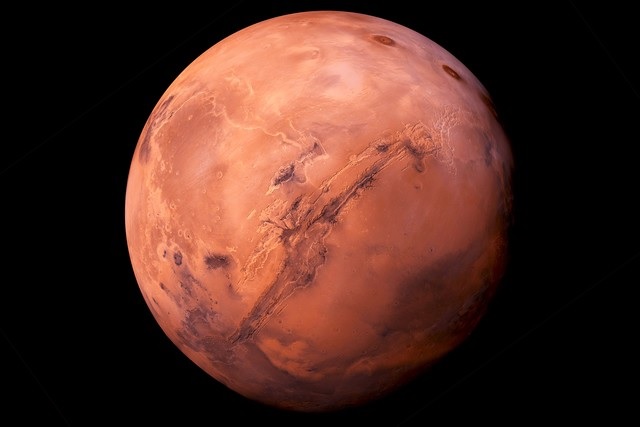
China's Chang'e 5 robotic mission created history when it brought back samples from the lunar surface in 2020, and now, Chinese space scientists have set their sights on another celestial body — Mars.
According to Wu Yanhua, chief designer of China's deep-space exploration programs, the nation plans to bring Martian soil back to Earth around 2030. The mission has been named Tianwen 3, which means it will be the third in China's interplanetary exploration schedule.
The Tianwen 3 robotic probe will have four components — a lander, an ascender, an orbiter and a reentry module — and will be launched on two Long March 5 heavy-lift carrier rocket flights from the Wenchang Space Launch Center in Hainan province, Wu said on Tuesday during the First International Deep-Space Exploration Conference (Tiandu Forum) in Hefei, Anhui province.
The lander and ascender will take an Earth-Mars transfer trajectory and carry out orbital correction maneuvers before entering the Martian orbit, after which they will attempt an engine-assisted soft-landing.
Meanwhile, the orbiting stack — the orbiter and reentry module — will follow the same path to reach the Martian orbit, after which they will fly around Mars to relay signals and wait for the samples.
Once the samples are collected and packed into a vacuumed metal container, the ascender's engines will elevate it to orbit to rendezvous and dock with the reentry module, transfer the samples and undock.
The orbiting stack will then leave the Martian orbit and return to the Earth's orbit, where the pair will break up and the reentry module will conduct a series of complicated maneuvers to return to a preset landing site.
If everything goes according to plan, the samples could become the first to be returned to Earth from Mars, and will help scientists look for traces of life on Mars, learn more about the planet's geology and inner structures, and understand its atmospheric cycles and escape process, Wu said.
All this will allow researchers to expand their knowledge about the creation and evolution of Mars, he added.
China launched its first Mars program, Tianwen 1, in July 2020. It was the country's first independent interplanetary exploration endeavor.
The landing craft of Tianwen 1 touched down on the Martian surface in May 2021 and then released a rover, named Zhurong, to perform scientific tasks. Zhurong has traveled 1,921 meters on Mars is currently dormant.
Tianwen 2, a robotic mission to retrieve samples from an asteroid, is scheduled for launch around 2025 and is expected to return to Earth with samples around 2027, according to Wu.
In another development, China is also planning an asteroid defense exercise that will involve using a high-speed spacecraft to make a hyperfast, kinetic impact on an approaching asteroid with a diameter of about 50 meters, Wu said.
This technology can deflect a potentially hazardous asteroid, putting it on a different trajectory and steering it away from the Earth's orbital path, he said.


- Shanghai Qingpu melodies festival wows crowds
- Chinese 'self-media' accounts penalized for misleading publishing
- Tourists flock to Hainan for May Day holiday
- A Date with Shandong: Weifang, the city painting the sky
- Liuzhou incident leaves 4 dead, 1 injured; investigation underway
- Communist Youth League of China has nearly 78.34 million members





