


Cherishing the gifts of ancestors
Ancient tea trees are central to livelihoods and traditions of ethnic groups living in Yunnan province's Jingmai Mountain, Deng Zhangyu reports.










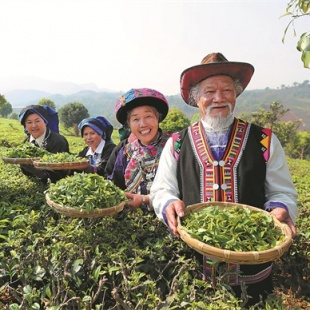
They even weave tea leaf patterns on to the heart area of the costumes worn at ceremonies. They maintain a relationship with nature that has lasted for centuries — tea trees are cultivated in forests while farmland and human settlements are placed far away to avoid interference.
According to Su, the Blang people's utilization of tea has experienced four phases. At first, their ancestors considered tea a kind of medicine. Later, they cooked it with food or even ate it. Several hundred years ago, when tea started to become an important commodity on global markets, they used it as a kind of currency to trade for necessities. Now, it's the key cash crop for the group.
"Although we make a fortune from these natural gifts, we should still maintain our reverence for them," says Su, who in the past three decades has spent time compiling the history of the Blang, spreading the ethnic group's traditional culture and helping improve the educational background of the younger generations.
"To better protect the ancient tea trees and put our ancestors' words into practice, education is important," says Su, who has set up a school in Mangjing village.
Nan Kang, leader of Mangjing village, recalls that life used to be quite simple in the past, with people rarely leaving their home.
In recent years, new lifestyles and cultural patterns have been introduced and gradually begun to transform Blang society.
However, people have attempted to maintain their connection with nature, for example, refusing to use chemical fertilizers and pesticides and retaining their traditional way of tea tree cultivation.