



Boarding schools facilitate learning in Tibet









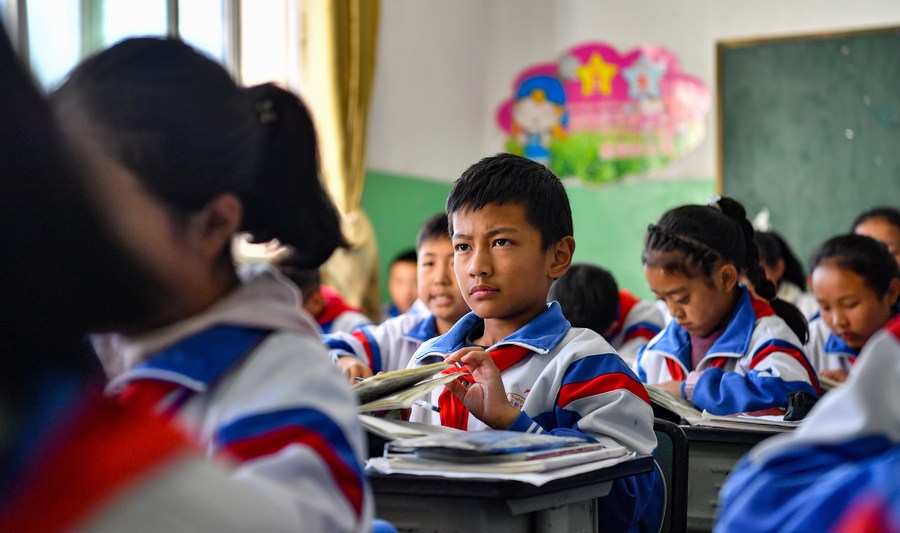
Most herdsmen in the Tibet autonomous region live in sparsely populated areas, causing great difficulties for their children to commute between home and school on a daily basis.
As stipulated by the Compulsory Education Law, the government started offering optional and free boarding services at local schools to resolve this problem in the 1980s. That's why most schools in Tibet today are of a mixed model consisting of resident and non-resident students.
After about four decades of development, the management of the boarding services is professional and considerate, ensuring the safety and comfort of the students, who can visit home on the weekends, during the school holidays and on sick leave or due to other personal matters if necessary.
The government started providing free school buses for the resident students at the beginning and end of their semesters in 2011 so that those living far from school, particularly those from low-income families, can enjoy safe and care-free journeys home and back to school.
The communication channels between the resident students and their families are always open when they are at school. Some schools also invite representatives of the parents to directly participate into the management of the boarding services as supervisors as well as a bridge between the students and other parents.
The schools in Tibet attach special significance to encouraging the students to learn the Tibetan language, culture and arts. They not only have courses on Tibetan language, opera and dance, thangka, a traditional Tibetan painting on cotton, silk applique, and other symbolic arts with distinct ethnic characteristics, but are also encouraged to explore innovations to inject new vitality into the traditional arts so that they can better adapt to the fast-changing world today.
Since the boarding services were introduced in Tibetan schools, they have greatly facilitated the education of children at schooling age of all ethnic groups in the region, and contributed to the inheritance and development of the Tibetan culture and the protection of local lifestyle.
For most of its history, the illiteracy rate in Tibet was as high as 95 percent, which was exactly the proportion of serfs in Tibetan population at that time, as only the serf owners and those above in the social hierarchy were entitled to the limited education resources.
At present, the average length of schooling has increased to 13.1 years thanks to the founding of a modern education system in the region.
— CHENG DONGYA, PROFESSOR OF TIBET UNIVERSITY, AND BAI LIANG, PROFESSOR OF NORTHWEST NORMAL UNIVERSITY





