


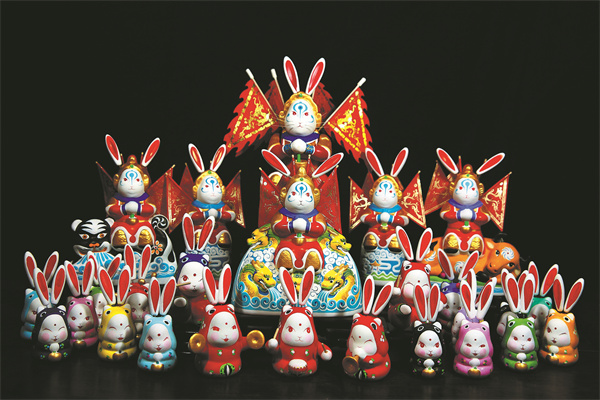
As you walk into the Shandong Arts and Crafts Exhibition Center, you are greeted by a magnificent sight: a larger-than-life rabbit. Perched atop an auspicious cloud, the Tuzi Wang, or "lord rabbit", is resplendent in a golden helmet, armor and a flowing red robe, complete with four banners on its back.
Its face is adorned with an artistically painted Chinese character, quan, and the cloud beneath it features the landscape of Baotu Spring, one of the most famous scenic spots in Jinan, the capital city of Shandong province, East China.
The creator of the rabbit figure is Yang Feng, 52, an inheritor of this Shandong intangible cultural heritage. Located on the second floor of the exhibition center is his studio, where he displays his works, in different designs and sizes, as well as the legends and stories associated with them.
From a large rabbit general who has an imposing and majestic appearance to a small rabbit baby who looks cute and adorable, Yang's artistic works are exhibited. Yang named his works "Quancheng Tuzi Wang", with quancheng meaning "the capital of springs" — a nickname for his hometown, Jinan.
After dedicating two decades to perfecting his craft, Yang is committed to preserving and evolving the traditional skill of creating the lord rabbit in his own unique style.
"For me, crafting the rabbit is not just a job, but a lifelong career that I am passionate about," he says.
Hou Yangjun, the deputy secretary-general of the Chinese Folk Literature and Art Association, explains that the practice of worshiping the moon with the rabbit god can be traced back to the Ming Dynasty (1368-1644) and was practiced mainly in Beijing, Tianjin and Shandong's Jinan and Qingdao.
"The rabbit god is known as Tu'er Ye in Beijing and Tuzi Wang in Jinan. Despite minor differences in their appearance, both of them share the same origins and have been passed down for several centuries. They are traditionally crafted from mud and clay," Hou says.





