Book restorers touch history









A doctor of paper treasures
The primary objective of ancient book restoration is to extend the life span of the document. The higher the similarity between the original and the restoration materials, the more consistent their rate of aging will be, and thus the better the ancient books can be preserved.
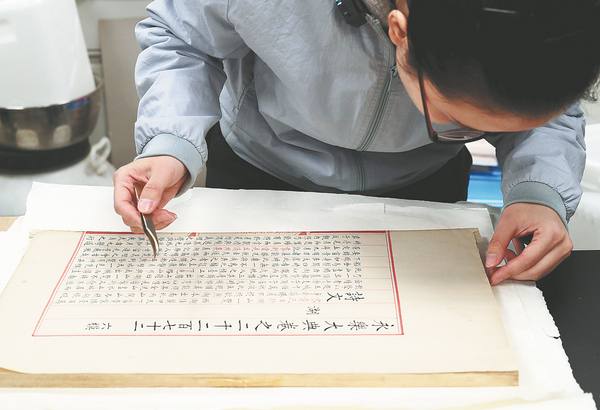
At the moment, Song and her colleagues are working on restoring a copy of Yongle Dadian, an encyclopedia completed in 1408 after being commissioned by Emperor Yongle during the Ming Dynasty (1368-1644).
It is estimated that Yongle Dadian, which comprises 22,937 volumes in 11,095 books, contains some 370 million Chinese characters. It is said to be the world's largest paper-based encyclopedia in ancient history.
Time has taken its toll, and only about 400 books of a 16th-century duplicate, or just more than 3.5 percent of the total publication, are known to exist, while the whereabouts of the original version is unknown.
After receiving the challenge at the beginning of last year, it took Song and her colleagues six months of assessment before they started the restoration work.
They had to figure out ways to simulate the original raw materials for binding and layout through meticulous study.
"Most books from Yongle Dadian that have survived until today have suffered damage to their original binding," Song says.
"To restore them to their original form, we need to gather information from various sources, such as images and texts, before we can make a conclusion as to their original binding style and repair them accordingly," she explains.
Moreover, the ancient encyclopedia's silk texture and color have both grown inconsistent, which makes creating the necessary raw materials and matching the color difficult.
"It could only be settled through trial and error, and we had to make sure the repair materials were pretreated to emulate the similar aged condition as the original," Song explains.
In the past, restorers had to rely on their experience to determine the appropriate materials to use on a project.
"When I first learned restoration, my teacher would ask us to identify the material used to make a piece of paper by hand," Song recalls.
As technology has evolved, Song and her colleagues are able to make use of a new method of fiber analysis through microscopes to identify the raw materials with accuracy and efficiency.
However, the old-fashioned, tactile detection methods still come in handy when fibers are not readily available.
"After all, getting fiber samples might undermine the integrity of an ancient item," she says.
After the analysis is finished, restorers at the library can create paper that is incredibly similar to the original.
However, technology is only an auxiliary resource in the trade, and ancient-book restoration still requires a set of essential manual skills, ranging from concocting paste, cutting and brushing paper, and binding.
Fearing the chemicals in commercially produced pastes might harm the books, Song and her colleagues have to make the glues they need by themselves, starting from extracting starch from flour.
It requires a lot of practice before getting all of them down to a fine art, Song says.
For example, the paste viscosity cannot be too weak or too strong. "Otherwise, it can't hold the paper together or will make the paper crease," Song says.
The restoration also requires high levels of control in brushing the paper.
"If the pressure is not properly controlled during the brushing process, the paper may tear, but if the touch is too light, the paper won't adhere," Song explains.