



Beibu Gulf Port stands out from crowd









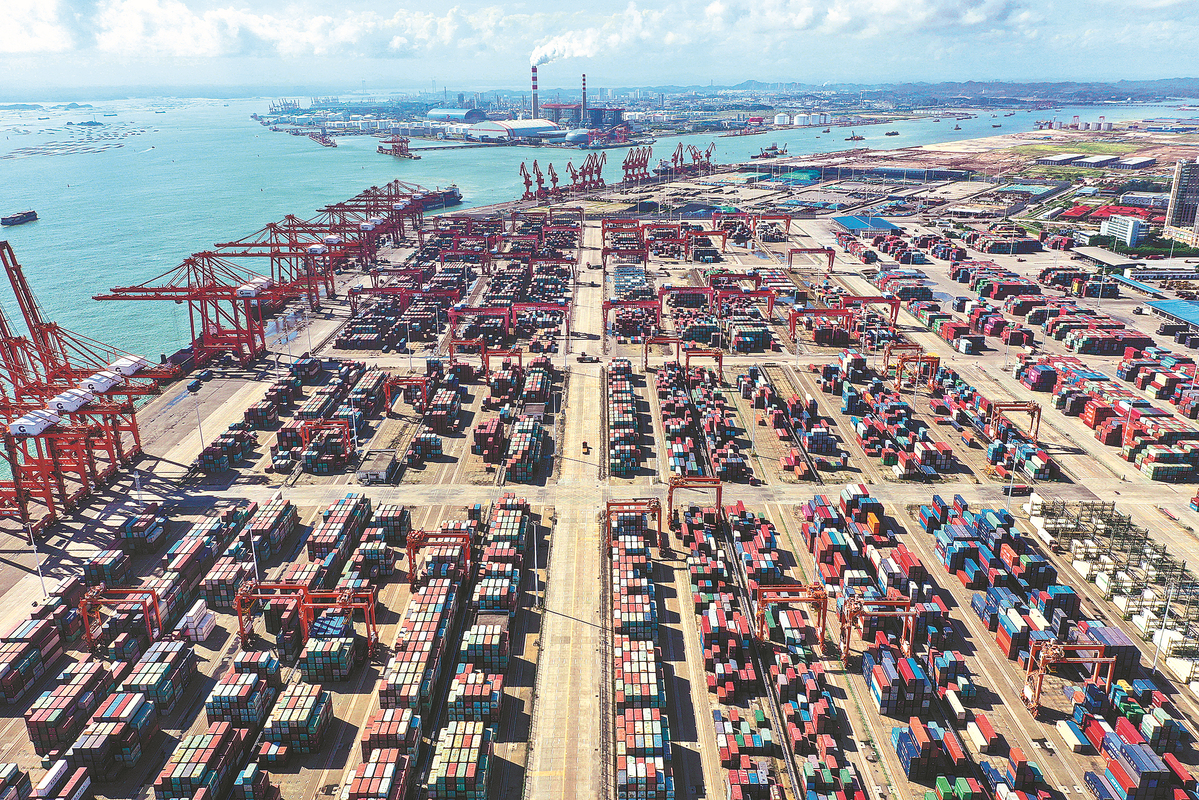
While many foreign and domestic ports face pressure to raise container throughput, Beibu Gulf Port in South China's Guangxi Zhuang autonomous region is bucking the trend after seeing growing container throughput in January, said its operator.
The port's container throughput during the month amounted to 558,100 twenty-foot equivalent units, up 15 percent year-on-year, according to the latest information released by Beibu Gulf Port Group, a Shenzhen-listed company.
With advances in new land-sea transit routes in western regions of the country as well as the Regional Comprehensive Economic Partnership agreement, the port has been making efforts to explore supply sources in western China, said the group.
Disrupted by the COVID-19 pandemic, softening external demand and geopolitical shocks, container throughput at major foreign ports like Singapore fell by 4.9 percent year-on-year to 2.99 million TEUs in January, while the Port of Los Angeles in the United States processed 726,014 TEUs, dropping 16 percent on a yearly basis, according to information released by global shipping and port news provider PortNews.
China's major port cities in both the Yangtze River Delta and Pearl River Delta regions are also confronting similar challenges. For example, Ningbo-Zhoushan Port in Zhejiang province and Guangzhou in Guangdong province both recently announced that they lowered their expectations for container throughput in January. Their final operational figures for the month have not yet been published.
Domestic ports in these two regions have more routes to markets in Europe and North America. The current decline of goods demand in these markets has caused a decrease in container throughput, said Lei Xiaohua, a researcher at the Guangxi Academy of Social Sciences in Nanning.
Lei said new containers manufactured over the past three years have also increased overall container supply. This has resulted in large container pileups at ports in many parts of the world.
Compared with other key ports in China, Beibu Gulf Port has been able to capitalize on growing trade volume between China and the Association of Southeast Asian Nations. China's trade volume with ASEAN has been soaring after the RCEP agreement came into force in January 2022, he added.
Comprising the ports of Fangchenggang, Qinzhou and Beihai, Beibu Gulf Port serves as an important transit point in the New International Land-Sea Trade Corridor, a trade and logistics passage jointly built by western Chinese provincial regions and Singapore.
The port currently runs 75 container routes and has access to 335 ports in 113 countries and regions across the world, according to Guangxi's regional department of transportation.
In addition to opening 11 new container routes, Beibu Gulf Port handled 7.02 million TEUs of containers in 2022, up 16.8 percent on a yearly basis.
Since ASEAN has become China's largest trading partner, Beibu Gulf Port — backed by its well-developed shipping routes to various ASEAN member economies — will help alleviate the pressure on China's foreign trade this year, said Li Muyuan, vice-president and secretary-general of the Beijing-based China Container Industry Association.
Wang Guowen, director of the center for logistics and supply chain management at the China Development Institute, a Shenzhen-based think tank, said many Chinese ports will face pressure from slowing external demand from European and North American routes. However, China's increasing shipping activity to and from ASEAN will continue to grow this year.
He said that closer trade ties will also boost cooperation in various fields such as tourism, digital economy, green energy and healthcare, promote regional connectivity, and enhance the resilience of supply chains between China and ASEAN in the next stage.
Trade between China and ASEAN grew some 15 percent year-on-year to 6.52 trillion yuan ($943.97 billion) in 2022, said the General Administration of Customs.




















