


Fossils reveal marine life revival after mass extinction









A trove of newly-discovered fossils in Southwest China revealed how modern marine animals, like fish and lobsters, thrived in the immediate aftermath of a mass extinction event more than 250 million years ago.
The study published last week in the journal Science described the finely-preserved fossil assemblages unearthed near Guiyang, Guizhou province.
The assemblages represent the oldest ever-known lagerstatte, or a sedimentary deposit that exhibits extraordinary fossils with exceptional preservation, and demonstrates the rapid rise of a resilient modern-type of marine ecosystem, according to the study.
The "Great Dying" took place about 252 million years ago and is believed to be the Earth's most severe known extinction event. It wiped out more than 80 percent of marine species, taking its worst toll on sessile organisms in the ocean and making room for mobile ones.
How soon the new ecosystem, with a complete pyramid structure including predators and prey, came about remains poorly understood due to the scarcity of well-preserved fossils, according to the study.
A group of paleontologists led by Song Haijun from the China University of Geosciences (Wuhan) chanced upon a rarely-seen lobster fossil fragment in early 2015, before they started an eight-year excavation project.
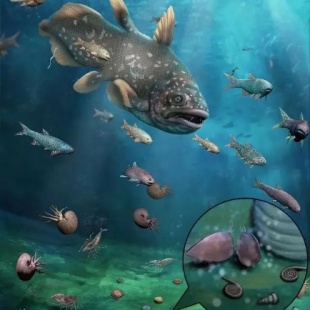
Their continuous field work unveiled an unprecedented snapshot of ancient animals comprising at least 12 classes and 19 orders, revealing a complex marine ecosystem, including diverse fish and crablike animals.
The new assemblages covered multiple representative species ranging from 100-micron primary consumers to 1-meter-long predatory fish, as well as abundant excrement fossils, which formed complex food chains and a complete ecological structure at that time.
The scientists used high-precision Uranium-lead dating and revealed that, despite a harsh marine environment, this ecosystem appeared only about 1 million years after the severe extinction event, earlier than previously believed.
It filled a 3-million-year gap of complex marine fauna, according to the study.
"Although the Guiyang biota remains incompletely sampled, it highlights that a slow and gradual recovery model does not apply to the period that followed this mass extinction," says Song.
The period after the Great Dying is often portrayed as a super-hot world in which tropical life was expelled poleward, but the new findings from the Guiyang biota hint at cooling gaps in the tropics without lethally-hot temperatures, and these gaps supporting a thriving marine system in that region, according to the study.
The study "gives us new insights into the rate and nature of the recovery of life after this largest-of-all mass extinctions," according to one of the paper's reviewers.
"In the foreseeable future, Guiyang biota can definitely deliver more surprises and provide clues as to the origins of the modern marine ecosystem," says Song, the paper's corresponding author.