


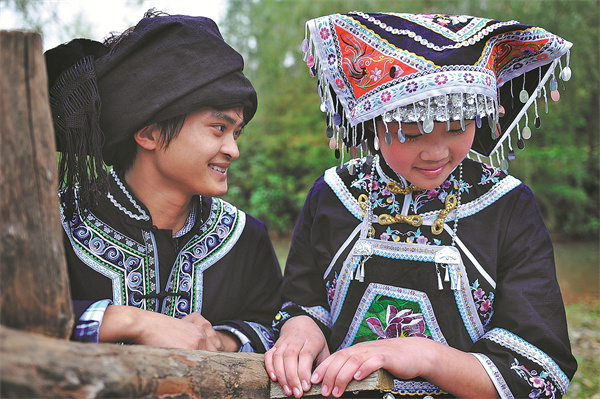
Wang started off as a designer at a batik workshop in Guizhou's Anshun city, where she saw that international visitors showed a strong interest in ethnic clothes.
It spurred her on to further tap the potential of aboriginal costumes.
In her spare time, she trekked across the province, visiting Bouyei villages spread far and wide in search of original costumes and manufacturing techniques.
"During my research, I found the ancient treasures were slowly disappearing," she says.
"Some century-old embroidery skills that require 100-percent handwork were nearly lost, and I feel obligated to protect and pass on these national cultural treasures."
Therefore, she made up her mind to return to her hometown of Xingyi to promote and inherit the traditional art.
Wang attributed the lackluster development of ethnic costumes to uneven production quality, monotonous style and lack of design.
Her previous learning and expertise had made her sharply aware that upgrading the costume design and standardizing production quality was the only way to revive the craft.
In 2001, an opportunity for Wang to demonstrate her skill arose when local authorities staged a rafting festival in Xingyi.
Wang immediately approached the organizers and bid for the task of making the ethnic costumes for tour guides and rafting participants. She won the organizers over after presenting her meticulous designs.
Two weeks later, a batch of costumes displaying fine workmanship, novel styles and unique ethnic characteristics were delivered and became a highlight of the event.
This initial success encouraged Wang to start her own ethnic clothing business in 2002.
She has since encouraged local women to join her and offered them training.
"I was thrilled to see many women still keep the tradition of weaving cloths and batiking," Wang says, recalling her research visits to the villages.
She considered it valuable and felt it imperative to bring the techniques to the public eye.
Wang invited the rural embroiderers to her workshop and taught them advanced ethnic costume craftsmanship. Afterward, they were able to make costumes from home.
To date, she has given training to 9,000 local embroiderers, including more than 1,000 Bouyei women, across the Qianxinan Bouyei and Miao autonomous prefecture.
Whenever she encountered a problem during her research, Wang would waste no time in trying to address it. For instance, when locals were concerned about the color fade of plant-based dyes, she found science institutes to tackle the issue.
Wang would also purchase ethnic handicrafts from villagers to reinforce their confidence in the traditional art.
At the same time, Wang has continued to collect and collate Bouyei costumes through field trips.
"I stumbled upon some costumes that are more than 100 years old," Wang says.
"The owners didn't wear them any more and readily gave them to me, and I would send them some gifts in return," she adds.
In 2016, Wang set up a Bouyei costume museum which displays more than 400 intangible cultural heritage items, mainly related to costumes that she has collected over the past two decades.
The museum has since received many students from institutes of higher learning, including Peking University, Tsinghua University, and the University of Hong Kong. More than 10,000 international visitors, including those from South Africa and Nepal, have knocked on her door to savor the region's distinctive costume culture.
Wang's ethnic costumes, with their innovative elements, have also made their way overseas, including to the United Kingdom, Russia and Singapore.
Currently, major Bouyei costume making elements are spread across 11 cities, counties and districts in Guizhou, according to Shi Jingyi, an official from the Guizhou culture and tourism department.
Local authorities will set up Bouyei costume research facilities in the province's southern, central and western areas. Related intangible cultural heritage workshops and production sites will also be established.
"Only if we ensure the authenticity, integrity and inheritance of the intangible cultural heritage, can it survive and thrive," says Long Youming, director of the provincial intangible cultural heritage protection center.
Long believes that ethnic costumes will play a positive role in Guizhou's tourism development and empower local culture and rural vitalization.
As Guizhou's infrastructure and tourism improved, Wang has noticed how cultural products with local ethnic characteristics are increasingly sought after.
"I will strive to enable Qianxinan Bouyei costume to find a global audience, through the integration of ethnic and ecological culture with fashionable elements to develop new products," Wang says.





