



Report paves way for advancing rule of law









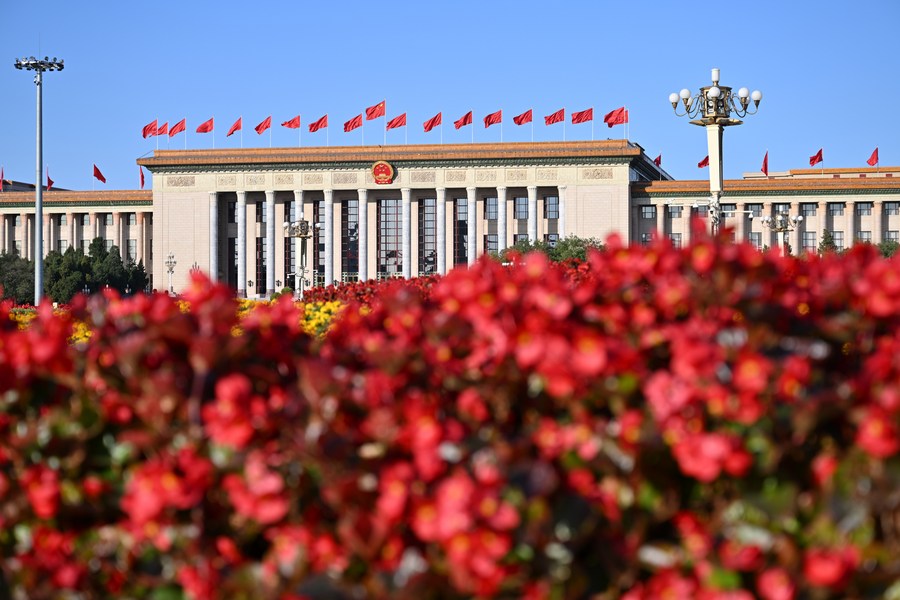
In his report to the just-concluded 20th National Congress of the Communist Party of China, Xi Jinping, general secretary of the CPC Central Committee, called for practicing law-based governance and advancing the rule of law in the country.
That the term "rule of law" has been mentioned 23 times in the English version of the report shows the great importance Xi and the Party attach to it. While previous Party congresses have laid emphasis on the rule of law, it is at the 20th Party Congress that the issue was highlighted in a standalone chapter for the first time.
In order to advance the rule of law, the report highlights four areas in which greater efforts need to be made: enhancing law-based governance through enactment of laws; advancing law-based administration; ensuring impartial delivery of justice; and promoting the rule of law throughout society.
In terms of legislation, the report underlines the Constitution's importance in resolving discrepancies among different statutes, and requires all sub-primary legislation to comply with the Constitution. This means there will be more constitutional reviews.
To identify potential breaches of the Constitution and laws, the National People's Congress Standing Committee has been vested with the power to review all laws and regulations. In the future, not only will the scope of the review be widened to include judicial interpretations, Party documents, supervision regulations and even military rules, but also the proceedings will be nuanced and review standards fleshed out. To do so, all kinds of normative documents will be used in the reviewing process, which will strictly comply with constitutional norms.
Besides, to make China's legal edifice more responsive, a large number of statutes, bylaws, rules and regulations will be codified in a way similar to the Civil Code, which was passed in 2020. For example, in the field of environmental law, a vast number of regulations, government bills and judicial interpretations related to environmental protection and national park conservation will be revised, interpreted, coordinated or even repealed and codified in one piece of legislation.
Apart from legislative work, the reform of the judicial system, too, will commence in due time. According to the congress report, judicial power should be brought to account, with security organs, procurators, courts, and administrative agencies performing their respective duties and coordinating with and checking one another. In this regard, the ongoing reform will continue with the aim of increasing judicial transparency and enhancing judicial efficiency.
In particular, judicial information will be disseminated through not only official portals, white papers, news conferences and traditional media, but also social media platforms such as WeChat and Weibo. As a result, more court rulings and verdicts will be made public.
Also, the Party has pledged to build a law-based government, with emphasis on improving the government responsibility system, increasing government efficiency and reforming the law enforcement procedures. That means the reforms to streamline administration and delegate power will continue.
It is also likely that the State Council, China's Cabinet, will keep delegating certain powers, administrative approval powers for instance, to lower-level governments. This could lift certain curbs on companies and remove red tape, freeing up market space, which in turn could help unlock market vitality and realize the goal of building a cleaner government.
In addition to the legislative, judicial and executive reforms, the congress report also promises to ratchet up efforts to advance the rule of law throughout society. Notably, the report says the rule of law should be promoted in China in a manner that is different from the Western stereotype, which means more traditional legal culture will be used and China's realities taken into account to advance the rule of law.
To promote Chinese-style rule of law, the report echoes what appears in the Five-Year Plan to Build the Rule of Law in China (2020-25), which says a socialist China under the rule of law will pursue coordinated progress and promote the integrated development of the country, the government and society.
Overall, the report pledges to make all-around efforts to ensure sound legislation, strict law enforcement, impartial administration of justice, and society-wide observance of the law. The 20th Party Congress has paved the road for advancing the rule of law and ushering in more, positive changes.
Zhu Zheng is an assistant professor focusing on constitutional law and politics at the China University of Political Science and Law. Cheong King Yau is a graduate student of constitutional law at the China University of Political Science and Law.
The views don't necessarily reflect those of China Daily.
If you have a specific expertise, or would like to share your thought about our stories, then send us your writings at opinion@chinadaily.com.cn, and comment@chinadaily.com.cn.





