



Is rising popularity of Han-style clothes a welcome trend?









Editor's note: Fashion is a common thug, wallet grub and a time piece mug, goes a saying, yet many are ready to suffer in the name of fashion. Centuries after it went out of fashion, Han-style clothing is becoming popular again. But how useful or convenient can Han-style clothing be in today's world, wonders a veteran journalist with China Daily.
I still have two Western brand suits that I bought 30 years ago. One reason I'm reluctant to dispose them is that, apart from costing me a fortune at the time, they used to be my luxuries in those days. Another reason is that, given the ever-changing dress fad, what today appears to be old-fashioned may become fashionable again.
I don't know whether my old suits will become fashionable again. And I rarely wear formal suits or keep track of trends nowadays. But I have noticed, with surprise, the growing popularity of Hanfu, or Han-style clothing, after being largely forgotten for centuries.
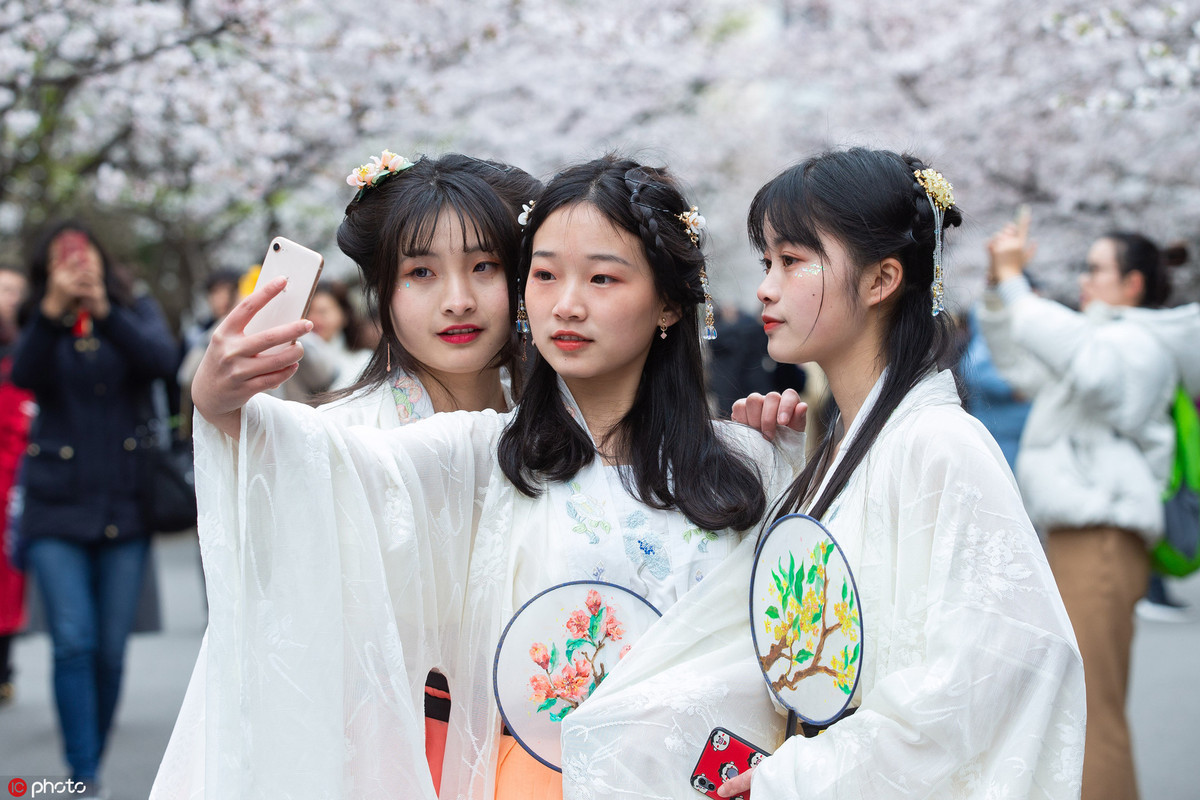
Walking in downtown areas or scenic spots in the Chinese mainland, one can't miss the sight of girls and boys (as well as women and men) elegantly dressed in Han-style clothing posing for photographs with either an oilpaper umbrella or a circular silk fan in hand. Wherever they go, they draw people's wondrous gaze.
The clothing style of Han Chinese kept changing over the centuries due to the changes in people's taste and requirements, and the availability of new clothing materials. The development of Han-style clothing came to a sudden stop, however, when the Manchus, after establishing the Qing Dynasty (1644-1911), basically banned people from wearing Hanfu.
For a long time, Hanfu was worn only by some brides and grooms during weddings and a few other special occasions. Attracted by the elegance and beauty of Hanfu worn by newlyweds and movie stars (in some films based on ancient stories), a few brave youngsters were dressed in Han-style clothes a decade ago to take photos in ancient towns like Xi'an, Shaanxi province, and Suzhou, Jiangsu province. They immediately drew the attention of the public and the media, which in turn prompted other people to try on Hanfu.
Over the past decade, thanks to the country's emphasis on cultural confidence, Han-style clothing has been developing into a trend. While a city in Henan province has held four Hanfu festivals, Chengdu, Sichuan province, has hosted Hanfu fashion shows and a scenic spot in Sanya, Hainan province, announced that those wearing Hanfu will be allowed free entry to the venue.
Hanfu fans have developed websites and written articles on Hanfu, attracting more than 4 billion page views on Weibo alone. The rising popularity of Hanfu has also fueled public interest in other traditional cultural elements. For instance, many after-school classes have emerged to teach children Sanzijing (Three Character Classic) and Baijiaxing (Hundred Family Names) — two classics used as "enlightenment education" textbooks in China for many centuries.
Besides, Chinese painting, calligraphy and kung fu are attracting more and more young learners while traditional Chinese medicine is returning to hospitals.
Although most people agree that Han-style clothes look beautiful on people on certain occasions, debates on whether the trend should be officially encouraged rage on. Those in favor of Hanfu say it represents Chinese culture and looks beautiful. In fact, two deputies to the National People's Congress once proposed to either make Hanfu the "national dress" to be worn by officials on important occasions or at least replace the Western-style graduation cap and gown with it.
Those against it claim that a set of Han-style clothing may cost thousands of yuan because they are handmade, not mass-produced, and thus could be a financial burden on youths. They also say putting on Hanfu and the accompanying accessories, not to mention getting a hairstyle to match the dress, is time-consuming. They may be right. A girl I met in Suzhou told me that she had to spend more than 1,000 yuan ($138) to rent a set of Han-style dress and get a makeup to go with it, which took two hours to complete.
Most people, however, tend to ignore such arguments. All they say that seeing people wholly or partly dressed in Han-style clothes while walking in a street is a "beautiful" experience.
The author is former deputy editor-in-chief of China Daily.
If you have a specific expertise, or would like to share your thought about our stories, then send us your writings at opinion@chinadaily.com.cn, and comment@chinadaily.com.cn.





