



Japan-Australia military cooperation should not target any third party: China Daily editorial









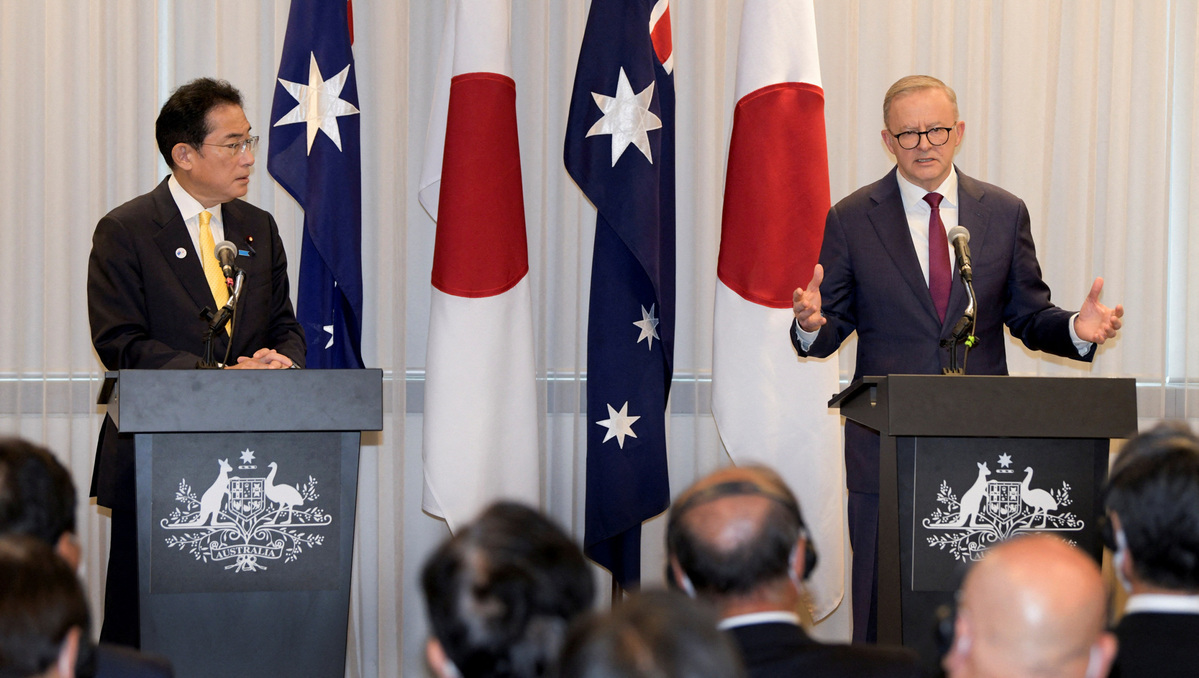
The current Australian Prime Minister Anthony Albanese, elected in May, has generally shown a positive attitude toward his country's ties with China by taking action to correct his predecessor's wrongs. But upgrading Australia's bilateral security agreement with Japan is not in line with that positive trend.
The upgraded Joint Declaration on Security Cooperation that Albanese signed with visiting Japanese Prime Minister Fumio Kishida in Perth covering military, intelligence and cybersecurity cooperation, is another move to strengthen security ties between the two countries. It follows the reciprocal access agreement that then Australian Prime Minister Scott Morrison signed with Kishida in January, which removed obstacles to holding joint military exercises in either country.
Kishida said that the upgraded agreement had been developed under an "increasingly harsh strategic environment", and that it "will chart the direction of our security and defense cooperation in the next 10 years".
Expounding on this, the Associated Press said that the new bilateral security agreement reflects "the deteriorating security outlook for their region driven by China's increasing assertiveness".
But this is a harsh and prejudicial judgment arrived at by viewing the regional situation through the prism of Washington's "Indo-Pacific strategy".
It is not China's "assertiveness", but the United States' ambition to contain China's rise with the aid of its allies that has caused the "deteriorating security outlook for their region". It has made a series of moves aimed at getting its regional allies to more actively support its bid to maintain its hegemony in the region, notably bringing them into the fold of the transatlantic alliance.
In June, Australia and Japan, along with the Republic of Korea and New Zealand, participated in the NATO Summit in Madrid. Commenting on this new development, a Chinese Foreign Ministry spokesman said: "We have always believed that the development of relations between countries should be conducive to world peace and stability, and should not target or harm the interests of third parties. The Asia-Pacific region is not within the geographic scope of the North Atlantic. Countries and peoples in the Asia-Pacific region firmly oppose any words or deeds that introduce military blocs and provoke separatism and confrontation."
In his National Day speech on Aug 21, Singaporean Prime Minister Lee Hsien Loong warned that the geopolitical tensions between the United States and China are affecting the security situation in the Asia-Pacific region.
He said that, "Our region has enjoyed peace for a long time, and it is difficult for us to imagine that the situation will be different. But look at how the situation in Europe has deteriorated, how suddenly and quickly".
The risks of any misjudgments are clear, and the anxiety triggered by China's bilateral security cooperation agreement with the Solomon Islands shows how easy it is for suspicions and mistrust to lead to misinterpretations of intentions.
China has repeatedly stressed that it stands ready to work with Australia to properly manage differences, and steer the sound and steady development of bilateral relations.
On Sept 22, State Councilor and Foreign Minister Wang Yi met with Australian Foreign Minister Penny Wong on the sidelines of the United Nations General Assembly in New York, and the two agreed that the two sides would make joint efforts to develop a stable, mutually beneficial and productive relationship through candid communication and constructive exchanges on the basis of mutual respect.
Creating a favorable environment for the sound development of China-Australia relations would be in the interests of both countries and the region as a whole. Canberra should not let itself be swayed in the wrong direction by Washington.
As has been observed, "The Pacific is big enough to hold China and the US."
It is also big enough to hold China, the US, Japan, Australia and all the other countries in the region.





