


The most salient examples of this effort lie with a small collection of cloisonne and porcelain enamel vases Lu has put on view. Taking the elegant shapes of the ancient ritual bronzes from the Shang Dynasty (c.16th century-11th century BC), these late reincarnations traded their predecessors' time-honored patina for a vibrant palette exuding a more worldly charm. The ornate patterns, on the other hand, somehow evoke the eye-bewildering and precise surface designs the original vessels had borne.
Around the time several of these vases were made, in the late 17th to 18th century, what Lu calls "the second transformation" was taking place, with the introduction to China of new European enameling materials and techniques.
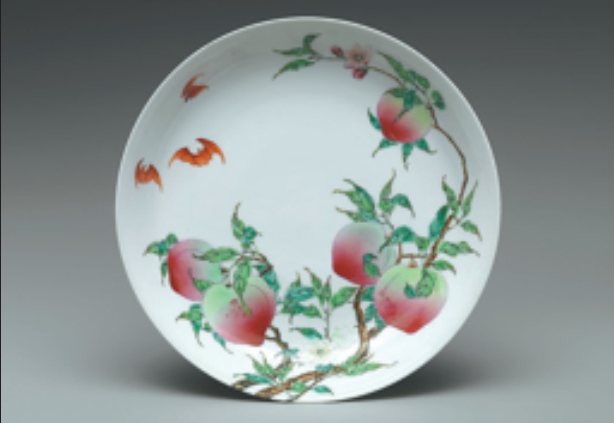
The new approach, fittingly called painted enamel, offered a much wider range of colors and shades while allowing one to blend seamlessly into another in a way that made possible the vivid depiction of ripening peaches on an 18th-century porcelain plate. The tip of the peach is drenched in a deep rouge, which then gradually dissipates and melts into a pool of light, translucent green as it progresses toward the stem end of the fruit, an effect unimaginable with the previous materials that produced solid, non-mixable colors.
Apart from porcelain, copper-alloy wares also provided canvases for such painterly expressions. The exhibition's accompanying catalogue describes two flower-patterned painted-enamel-on-copper-alloy dishes as having an appeal to "Western traders interested in natural history".
"While royal endorsement had once again proved crucial for the flourishing of this new trend, when it comes to export, the market rules," says Lu, who has deftly woven into the second episode of his color story a narrative strand whose far end extends well beyond the border of China's last feudal empire.
Several painted-enamel-on-copper-alloy exhibits, all from the late 18th and early 19th century, stand out to shed light on this market. One is a moth-shaped inkstand with many compartments that are believed to have held, among other things, ink for a quill pen and wax with which the letter writer could stamp-seal his message. Another is a kettle and its matching stand. Adopting a typical European silverware design, the kettle features blossoms and leaves that echo English country-style tea sets.
"The European market's infatuation with China had already been evidenced by the popularity of Chinoiserie," Lu says, referring to the interpretation and imitation of Chinese style by European artists and artisans through the late 17th century and 18th century, in everything from home deco to garden design. "These Chinese exports, meant to satisfy the same desire, were feeding into and being fed by that phenomenon."





