



AI humans to play increased economic role









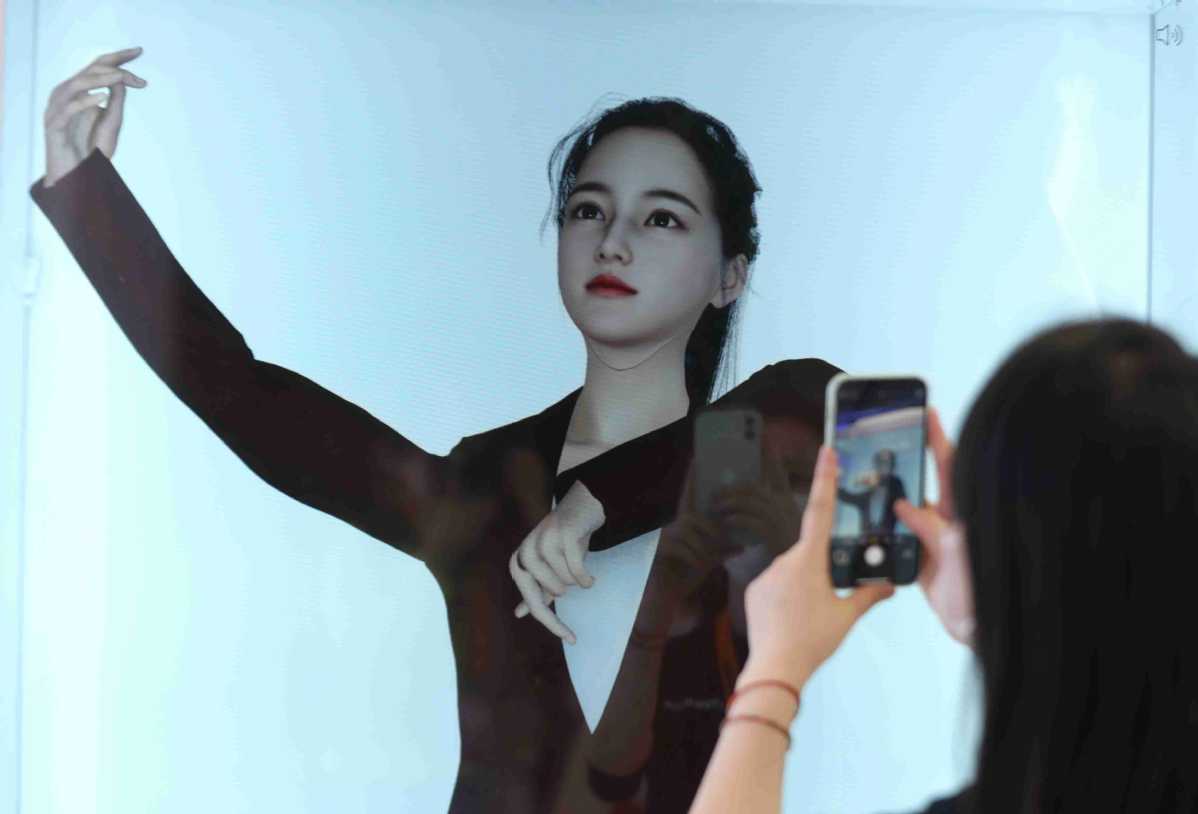
The capital aims to develop one or two leading virtual human companies by 2025 with revenue surpassing more than 5 billion yuan each, and 10 companies that would generate annual revenue of 1 billion yuan each, according to the plan.
The plan calls for efforts to develop virtual reality, augmented reality and mixed reality terminal equipment, and apply speech recognition, natural language understanding and other artificial intelligence technologies to improve the interactive qualities of virtual beings.
"Digital humans are already demonstrating clear business value in numerous fields today," said Lu Yanxia, associate research director at market consultancy IDC China. "In the future, there will be digital humans coexisting side-by-side with us in life and work."
Shen Yang, a professor with the School of Journalism and Communication at Tsinghua University, said breakthroughs in machine learning, deep learning and semantic understanding-as well as the maturity of 3D imaging sensors and improvement of computing power-h(huán)ave all laid a solid foundation for the development of the digital human sector.
Chinese AI pioneer SenseTime, Xiaoice and tech giant Huawei Technologies Co have also made forays into the digital human market.
Tian Feng, dean of SenseTime's Intelligence Industry Research Institute, said digital humans are being developed into more advanced and intelligent models comparable to human beings. "The AI-enabled intelligent service provided by digital humans can significantly increase productivity, facilitating the integration of the digital and physical economies," he said.
Digital humans can be divided into five levels based on their level of autonomy and similarity to human beings, according to a white paper released by SenseTime and China Augmented Reality Core Technology Industry Alliance.
AI-powered digital humans of level 4 can achieve intelligent humanlike interactions by performing natural facial expressions and body movements under most circumstances. Tian said the intelligent interactions realized by digital humans of level 4 or higher can be applied in many industries and scenarios.
For instance, SenseTime's digital human has acted as a shopping guide at Aeon Mall in Guangzhou, as well as a customer service representative in the Bank of Ningbo's Shanghai branch, providing inquiry services for customers.
Xiaoice, another Chinese AI company, developed Cui Xiaopan, the first virtual employee of Chinese real estate developer Vanke. This digital human is in charge of reminding employees to pay the company's bills on time and collect bills due. Huawei Cloud has created and hired its first virtual human employee named Yunsheng.
"Although the digital avatar sector is still nascent, the appearance, gestures and actions of digital humans will become more and more refined and closer to that of real humans," said Yu Jianing, executive director of the metaverse industry committee at the China Mobile Communications Association, a Beijing-based industry association.
The accelerated application of 5G and the research and development of next-generation wireless technology 6G will fuel the digital human industry, Yu said, adding that virtual humans will become more intelligent and be able to give personalized feedback based on real-time information as a result of advances in artificial intelligence.
Interactive experiences with digital avatars will need to be further improved to give users a greater sense of reality when interacting with virtual humans, said Pan Helin, co-director of the Digital Economy and Financial Innovation Research Center at Zhejiang University's International Business School.
Chen Duan, director of the Digital Economy Integration Innovation Development Center at the Central University of Finance and Economics, said new problems for the industry have also emerged, such as ethics, data security and personal privacy protection. Chen called for efforts to formulate relevant laws and regulations on the ownership of digital characters and the standardization of their behavior.
A lack of rules and regulations in the digital human industry might open the way for illegal acts, like online fraud, said He Yuan, secretary-general of the Center for Artificial Intelligence Governance and Law at Shanghai Jiao Tong University. "When virtual humans call you on the phone, it might be difficult to distinguish them from real people," he said.
In addition to oversight from the authorities, all parties engaged in the digital human industry should strengthen cooperation to prevent potential legal and ethical risks in advance, he said.











