



CAEXPO gathering highlights role of businesses and operators in RCEP yields









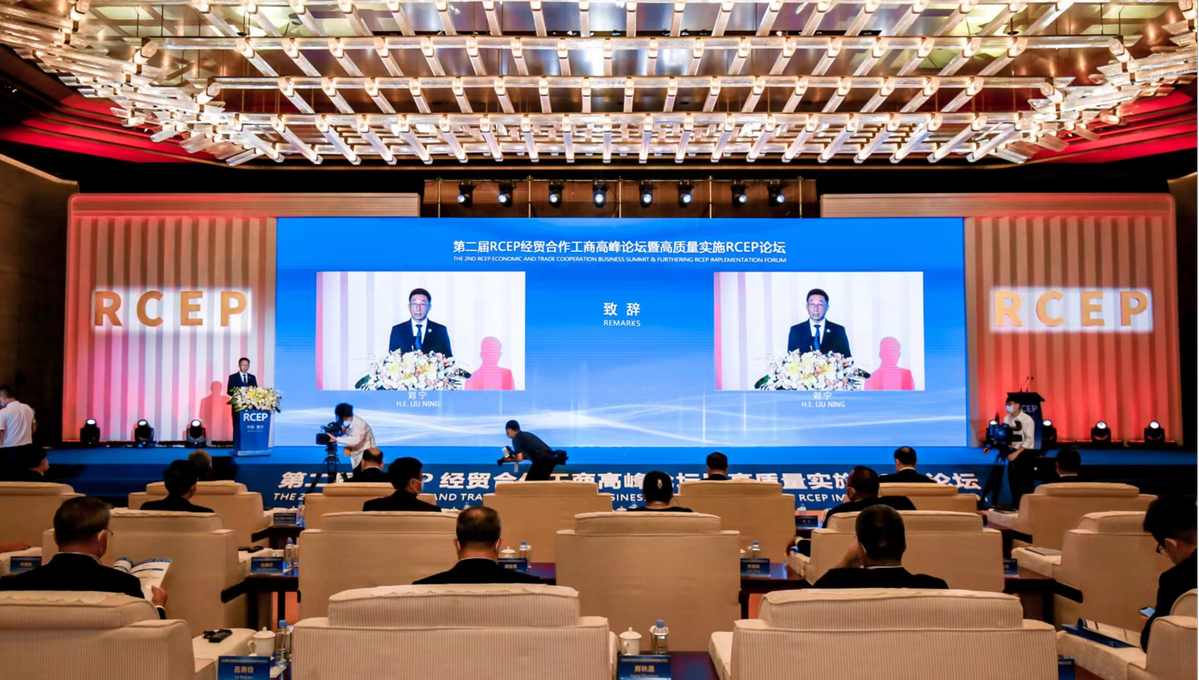
The business community needs to play a bigger role in the Regional Comprehensive Economic Partnership, or RCEP, to ensure bemefits from high-quality implementation of the world's biggest free trade pact.
"The RCEP agreement would only be able to deliver its promised gains if businesses and economic operators utilize the agreement," said ASEAN Secretary-General Lim Jock Hoi.
Lim said the benefits of the RCEP go much beyond tariffs as it covers streamlined rules and disciplines, as well as mechanisms for transparency and technical consultations.
Gao Yunlong, vice-chairman of the Chinese People's Political Consultative Conference National Committee, shared these views. "Businesses are an important force for carrying out the RCEP. Their active participation is the key to the high-quality implementation of the RCEP," he said.
Lim and Gao were speaking at the 2nd RCEP Economic and Trade Cooperation Business Summit and Furthering RCEP Implementation Forum, which was held on Sept 16 on the sidelines of the 19th China-ASEAN Expo in Nanning, South China's Guangxi Zhuang autonomous region.
The RCEP which entered into force this year, comprises the 10 members of the Association of Southeast Asian Nations, or ASEAN, and its five trading partners, China, Japan, South Korea, Australia and New Zealand.
Gao, who is also chairman of the All-China Federation of Industry and Commerce, said the free trade pact has brought tangible benefits.
For example, in the first seven months of this year, China's trade with other RCEP members rose 7.5 percent year-on-year, accounting 30 percent of China's total foreign trade.
In a welcome speech, Liu Ning, Party chief of Guangxi, said the entry into force of the RCEP was a concrete move to implement the Global Development Initiative and promote sustainable development in the Asia-Pacific region.
Liu said he hopes the forum can help promote regional economic cooperation and integration and contribute to the building of the Asia-Pacific free trade area.
Lim said the connectivity provided by RCEP will attract investment companies based in non-RCEP countries.
The agreement also includes elements which support businesses, particularly micro, small and medium-sized enterprises, to expand their markets in the region.
Members of the RCEP represent around 30 percent of the global GDP, 28 percent of the global trade, and 32.5 percent of the global investment, said Chhuon Dara, minister attached to the Prime Minister and secretary of state of the Ministry of Commerce of Cambodia, the chair of the ten-nation ASEAN bloc this year.
RCEP is not just a free trade agreement, but also a driver for regional economic recovery from the pandemic and an effective instrument for strengthening economics and trade, as well as offering room for political harmony among the members involved, said Chhuon.
Clare Fearnley, New Zealand Ambassador to China, said the reduction and removal of tariffs, new investment possibilities and new markets are important elements of the RCEP for all members.
"For New Zealand, we also see the areas of services as where big gains will be made, as well as through addressing non-tariff barriers," said Fearnley, noting the country looks forward to continued close cooperation with China and other RCEP members of the World Trade Organization.
Attended by over 300 delegates from governments, businesses, and academics, the summit held discussions on the high-quality implementation of the RCEP.
Li Yanqiang, president of the Beibu Gulf Port Group, said the RCEP had caused logistics demand to increase drastically, making the port more open and prosperous.
Between January and August, the port handled over 189,000 twenty-foot equivalent unit containers to RCEP countries, a year-on-year increase of 35 percent, said Li.
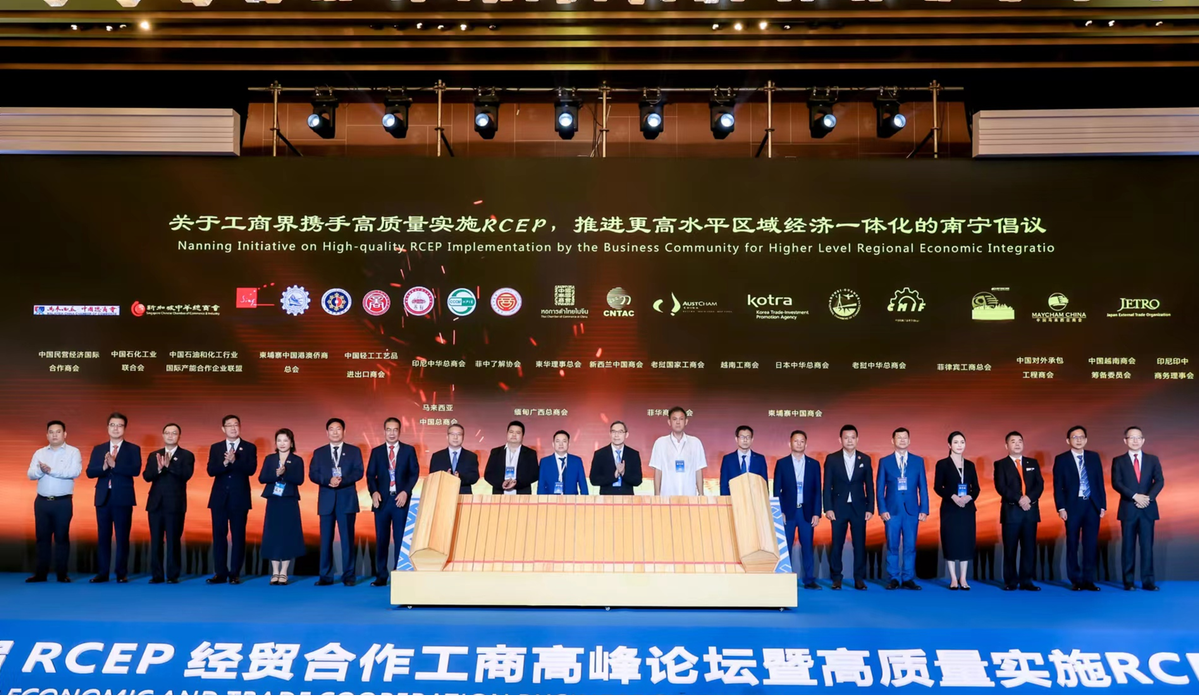
The summit also witnessed the launch of a Nanning Initiative by 40 business organizations from regional countries aimed at enhancing the implementation of RCEP to create higher level regional economic integration.











