



IPEF falters on taking its first step with India's exit









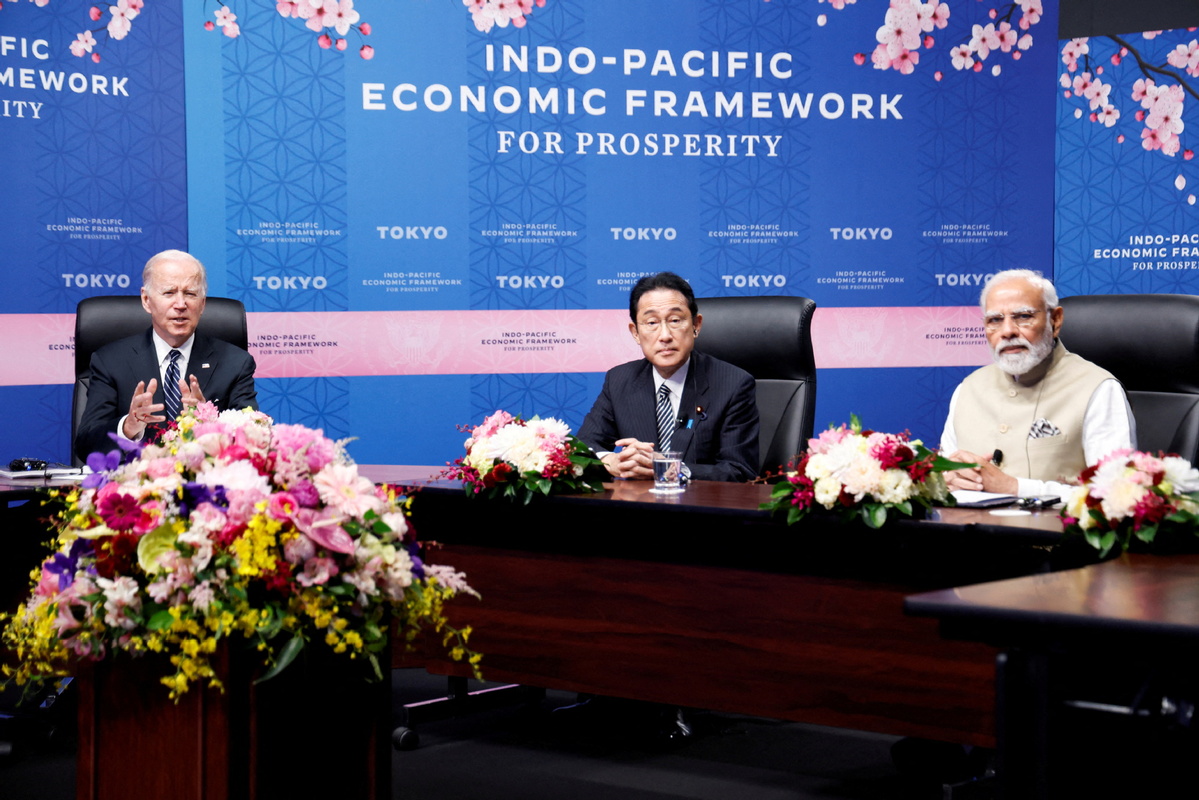
That India has said it will temporarily withdraw from the trade negotiations under the framework of the "Indo-Pacific Economic Framework For Prosperity", on the grounds that it can see no benefits in being part of it, undoubtedly deals a heavy blow to the United States as Washington regards the country as an indispensable partner in its efforts to contain China.
With India pulling out of the IPEF immediately after the US hosted the first in-person ministerial meeting on it in Los Angeles last week, it is fair to say that the IPEF has stumbled on its first step, even if India's move might be simply a negotiation tactic of New Delhi, since this has been a common ruse it has employed in recent years.
To the dismay of its host, instead of uniting the 13 participants, the conference has only served to convince them, as New Delhi's decision indicates, that the framework is nothing but a geopolitical tool of the US to advance its interests in the Asia-Pacific rather than a platform leading to multilateral trade deals.
The so-called cooperation in trade, energy, manufacturing, technology, and other areas that the US says is to be the hallmark of the IPEF is actually envisioned by Washington as a process of the US using its huge market to provide "friendshore outsourcing", or order contracts that will force the other participants to reduce their dependence on Chinese manufacturing by providing cheap labor for US companies.
Apparently, the plan does not sit well with the Narendra Modi government, whose ambition is to establish India as a hub for global manufacturing and supply chains, rather than as a low-level outsourcer exclusively serving the US.
It is also clear that India does not meet the high trade standards set by the IPEF, which will only undermine the competitiveness of Indian products.
At the same time, the IPEF has a natural flaw, as it will be one-way opening-up of markets, with the other participants expected to open their markets to US business, while the US will not open its in return. So the IPEF is not a regional trade mechanism, but rather a collection of US appeals gathered under one roof.
It was not difficult for India to see these flaws and inequities in the IPEF mechanism and its hesitation is totally understandable.





